FDA Issues Warning Letters to Five Unapproved GLP-1 Websites
October 1, 2026
- Approved GLP-1 Medications vs. Unapproved Peptides
- Semaglutide and tirzepatide
- Compounded medicines are a separate category
- What the Warning Letters Reveal About FDA Peptide Enforcement
- FDA Retatrutide Enforcement Actions: What Is Actually Known?
- Is the FDA Banning Peptides? Understanding the Latest Regulatory Developments
- What This Enforcement Action Could Mean for the GLP-1 Market
- Why did the FDA issue warning letters to five GLP-1 websites?
- Which five websites received FDA warning letters?
- Has the FDA banned GLP-1 peptides?
- What are the FDA's concerns about unapproved GLP-1 drugs used for weight loss?
- Is retatrutide FDA-approved?
- Does an FDA warning letter mean a peptide website must shut down?
- Can research peptides legally be marketed online?
- What is the difference between an FDA-approved GLP-1 drug and an unapproved peptide?
- Is the FDA conducting a broader peptide crackdown?
- How can consumers verify whether a GLP-1 drug is FDA-approved?
- Conclusion
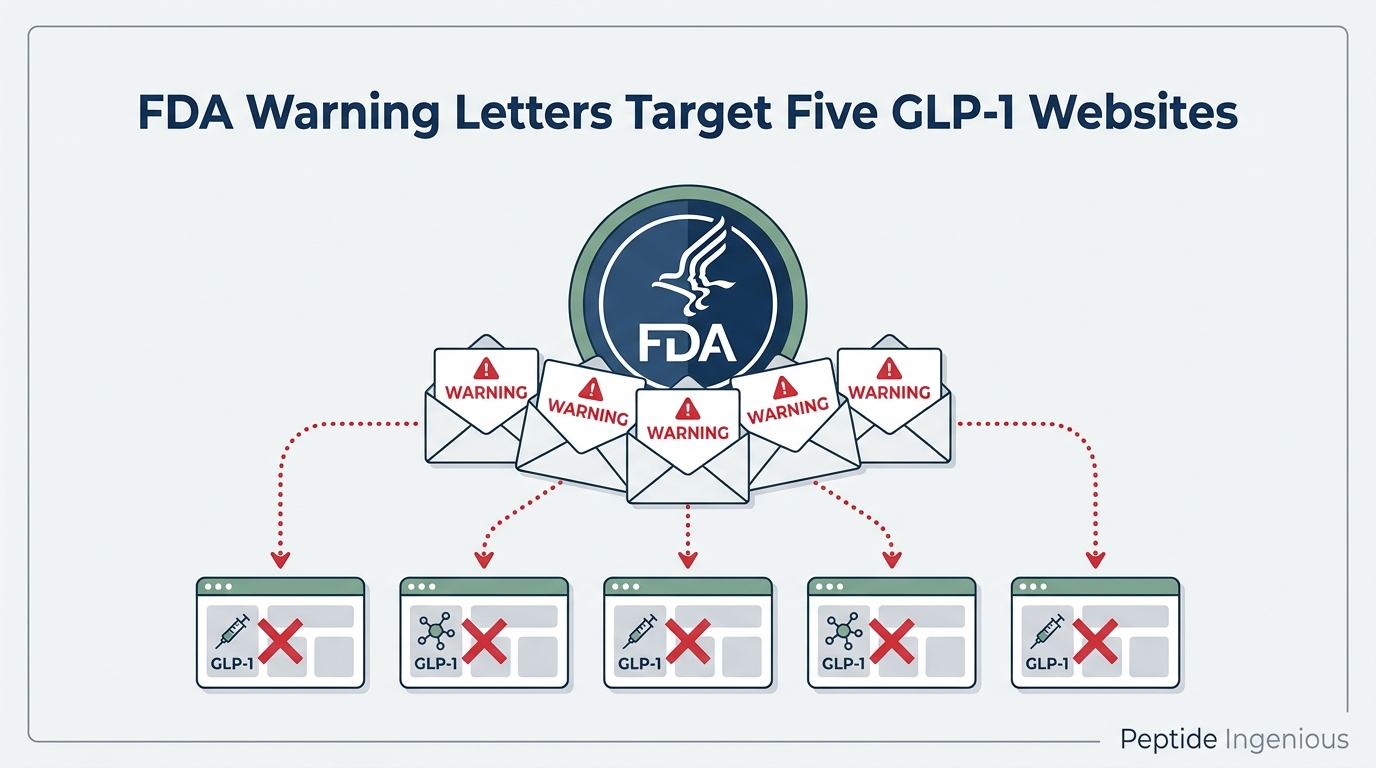
On August 24, 2026, the U.S. Food and Drug Administration (FDA) issued warning letters to five online peptide businesses marketing unapproved GLP-1 products and other substances. The agency identified products it considered unapproved new drugs, citing website representations that indicated intended human use despite research-use disclaimers. The letters gave the businesses 15 days to respond and warned of possible further regulatory or legal action. The enforcement targets specific businesses and products; it does not constitute a blanket ban on FDA-approved GLP-1 medications or all peptides.
Introduction
Why the FDA's Latest GLP-1 Enforcement Action Matters
The FDA's August 2026 warning letters to five online peptide businesses highlight the regulatory scrutiny facing websites that market unapproved weight-loss drugs and other biologically active substances. Issued on August 24, the letters targeted Peak Performance Peptides, Royal Peptides LLC, NuScience Peptides LLC, Peptide Partners LLC, and TXP Innovations LLC, which operates as Tex Peptides.
The action focuses on an important distinction in US drug regulation: a product's legal status depends on its actual intended use and applicable regulatory requirements, not simply on the disclaimer printed on its label or website.
The five businesses marketed combinations of substances including semaglutide, tirzepatide, and retatrutide. The FDA concluded that various products on the reviewed websites were unapproved new drugs and stated that describing them as research-use products did not negate evidence of their intended use in humans.
The warning letters are relevant to consumers, pharmaceutical companies, online peptide sellers, and businesses operating in the weight-loss market. They also illustrate why FDA-approved medicines, compounded drugs, investigational compounds, and products marketed as research chemicals must be considered separately.
Although the letters signal enforcement against the identified businesses, they do not establish that every peptide product is prohibited. Understanding the precise allegations, the applicable legal framework, and what happens after a warning letter is essential to interpreting the development accurately.
What Happened? FDA Targets Five Websites Marketing Unapproved GLP-1 Products
The FDA's warning letters, dated August 24, 2026, followed reviews of the five businesses' websites in July 2026. The agency identified products it classified as unapproved new drugs under Section 505(a) of the Federal Food, Drug, and Cosmetic Act (FD&C Act). It also identified website content that it considered evidence of intended human use, despite research-use disclaimers.
The five businesses named in the FDA letters
| Business | FDA letter reference | Date |
|---|---|---|
| Peak Performance Peptides | 735127 | August 24, 2026 |
| Royal Peptides LLC | 734884 | August 24, 2026 |
| NuScience Peptides LLC | 733652 | August 24, 2026 |
| Peptide Partners LLC | 735063 | August 24, 2026 |
| TXP Innovations LLC, doing business as Tex Peptides | 735067 | August 24, 2026 |
Which products were involved?
The five letters did not identify exactly the same product lists. The FDA's reviews covered combinations of semaglutide, tirzepatide, retatrutide, and other peptides. Some letters also identified bacteriostatic water or reconstitution solutions sold alongside products described as intended for injection.
| Business | Examples of products identified by the FDA | Principal concern |
|---|---|---|
| Peak Performance Peptides | Semaglutide, retatrutide, tesamorelin, SS-31, PT-141 and bacteriostatic water | Unapproved new drugs and evidence of intended human use |
| Royal Peptides LLC | Semaglutide, tirzepatide, retatrutide, tesamorelin, SS-31, PT-141 and BIMORELIN | Unapproved new drugs and evidence of intended human use |
| NuScience Peptides LLC | Semaglutide, tirzepatide, retatrutide, survodutide, mazdutide, tesamorelin and other products | Unapproved new drugs and evidence of intended human use |
| Peptide Partners LLC | Semaglutide, tirzepatide, retatrutide, tesamorelin, SS-31, PT-141 and reconstitution solution | Unapproved new drugs and evidence of intended human use |
| Tex Peptides | Semaglutide, tirzepatide, retatrutide, tesamorelin, SS-31, PT-141 and bacteriostatic water | Unapproved new drugs and evidence of intended human use |
The product examples summarize the respective FDA reviews and are not exhaustive inventories.
Why did the FDA reject the research-use disclaimers?
A notable feature of the letters was the FDA's treatment of language such as "for research use only" and "not for human consumption." The agency stated that, despite these disclaimers, evidence on the websites established that the products were intended to be drugs for human use.
The letters cited product descriptions and claims concerning potential effects on body weight, appetite, glucose regulation, metabolism, sexual function, and other physiological outcomes. The FDA also considered the sale of reconstitution products alongside injectable peptides relevant to its assessment of intended use.
The regulatory issue was therefore not simply whether the websites displayed a particular disclaimer. The FDA evaluated the overall evidence of intended use, including product descriptions, marketing representations, and how the products were presented for sale.
What did the FDA require?
The letters instructed each recipient to investigate the identified violations, take corrective action, and provide a written response within 15 business days of receiving the letter. The response was expected to describe the steps taken, explain measures to prevent recurrence, and include supporting documentation.
The FDA also invited recipients to submit information they believed demonstrated that their products did not violate applicable law. The letters warned that failure to adequately address the issues could lead to further regulatory or legal action, including seizure or injunction.
The letters themselves do not establish that the five businesses were subsequently shut down, that their owners were convicted of an offense, or that the agency had completed all enforcement proceedings.
Why the FDA Is Concerned About Unapproved GLP-1 Products
The FDA's central concern is that products marketed as drugs without the required approval may reach consumers without the agency having reviewed their safety, effectiveness, and quality. In the August 2026 letters, the agency specifically identified unapproved new drug violations and raised concerns about injectable products.
What makes a drug unapproved?
Under Section 505(a) of the FD&C Act, a new drug generally cannot be introduced into interstate commerce without an effective FDA-approved application, subject to applicable statutory exceptions.
A drug's regulatory classification depends in part on its intended use. Products represented as diagnosing, treating, mitigating, curing, or preventing disease—or as affecting the body's structure or function—may fall within the drug definition.
The FDA concluded that the products described in the five letters met the relevant drug definition and were unapproved new drugs for their marketed uses. This was the agency's regulatory assessment based on its website reviews, not a court's determination following a trial.
Why product quality matters
For medicines, quality involves more than whether a product's label identifies the expected active ingredient. Relevant considerations include identity, strength, purity, manufacturing controls, stability, and contamination prevention.
The FDA specifically highlighted risks associated with injectable products in the August letters. Because injections bypass some of the body's natural defenses, contamination or other quality defects can cause serious harm. The letters expressed concern about the products' potential risks; they did not establish that every product sold by the recipients was contaminated or had injured a consumer.
Regulatory violations versus demonstrated harm
A key distinction in regulatory reporting is the difference between an alleged violation and a demonstrated clinical injury.
The FDA can take action against a drug marketed unlawfully without first proving that a particular consumer suffered harm. A product may violate approval requirements even when there is no documented adverse event associated with it.
Conversely, the existence of a warning letter does not establish that every concern raised in it has resulted in a confirmed injury. The five letters should be understood primarily as regulatory communications identifying alleged violations and requesting corrective action.
Approved GLP-1 Medications vs. Unapproved Peptides
FDA approval applies to particular drug products and their approved uses. It does not automatically extend to every product containing the same active ingredient, every formulation sold online, or every compound with a similar mechanism. This distinction is central to understanding the five warning letters.
| Substance | Regulatory position in the United States | Relevant distinction |
|---|---|---|
| Semaglutide | Present in FDA-approved products, including Ozempic and Wegovy | Approval is product- and indication-specific |
| Tirzepatide | Present in FDA-approved Mounjaro and Zepbound | Approved formulations do not confer approval on online research products |
| Retatrutide | Investigational; not FDA-approved as of October 2, 2026 | Clinical investigation does not authorize general commercial sale |
| Survodutide | Investigational | Research status is not marketing authorization |
| Mazdutide | Not an FDA-approved US prescription drug | Approval in another jurisdiction, if applicable, would not equal FDA approval |
Semaglutide and tirzepatide
Semaglutide is the active ingredient in several FDA-approved prescription products. Ozempic and Wegovy have different approved indications and product labeling. Tirzepatide is the active ingredient in Mounjaro, approved for type 2 diabetes, and Zepbound, approved for chronic weight management and other specific indications.
These approvals followed the applicable regulatory review of the particular products. They do not mean that an unapproved vial or research-labelled preparation containing semaglutide or tirzepatide has undergone equivalent review.
A chemically related product can differ in formulation, manufacturing, labeling, and quality. Similarity to an approved drug is not the same as regulatory approval.
Compounded medicines are a separate category
Compounding is a recognized pharmaceutical practice that can serve specific medical needs. Under applicable federal law, certain compounding may be permitted when statutory conditions are met. Compounded drugs, however, are not FDA-approved, and the FDA does not review them for safety, effectiveness, and quality before marketing.
This distinction matters because the August 2026 letters concerned products the FDA classified as unapproved new drugs based on their presentation and intended use. They should not be treated as interchangeable with the separate regulatory questions surrounding patient-specific compounding.
What the Warning Letters Reveal About FDA Peptide Enforcement
The August action fits into a broader pattern of FDA oversight involving online marketing of unapproved peptide products and compounded GLP-1 medicines. However, different enforcement actions have addressed different regulatory problems, and they should not be treated as one continuous proceeding.
In December 2024, the FDA reported warning letters to online vendors, including Xcel Peptides, Swisschems, Summit Research, Prime Peptides, and Veronvy, over unapproved or misbranded GLP-1 products. That action predated the August 2026 letters and involved different recipients.
In March 2026, the FDA announced 30 warning letters to telehealth companies over false or misleading claims concerning compounded GLP-1 products. The agency identified representations that implied compounded medicines were the same as approved products, as well as claims that obscured who actually compounded them.
The August 2026 letters addressed another set of businesses: online peptide vendors whose websites offered products the FDA considered unapproved new drugs. The agency focused on product claims, intended use, and the sale of injectable products, including products marketed with research-use disclaimers.
Together, these developments demonstrate that FDA scrutiny can involve several distinct issues:
- Marketing an unapproved drug for human use.
- Making false or misleading claims about a medicine's approval or equivalence to an approved product.
- Misrepresenting the source or identity of a compounded drug.
- Introducing certain unapproved drugs into interstate commerce.
The specific legal basis and facts differ across these actions. The existence of several enforcement initiatives does not, by itself, establish a single formal policy banning all peptide products.
FDA Retatrutide Enforcement Actions: What Is Actually Known?
Retatrutide is an investigational drug developed by Eli Lilly. It acts on three receptor pathways—GIP, GLP-1, and glucagon—and has been studied for potential metabolic and weight-management applications. As of October 2, 2026, it has not received FDA approval for general prescription use.
Retatrutide is relevant to the August letters because it appeared among the products identified on several of the five websites. The FDA's concern was that the products were being marketed as drugs for human use without the required approval.
Its investigational status is an important distinction. A drug's participation in clinical trials or promising results from research do not establish that it can be commercially marketed as an approved medicine.
The FDA also addresses retatrutide separately in its guidance on unapproved GLP-1 products, stating that it cannot be used in compounding under federal law. The agency has described enforcement involving online marketing, distribution of active pharmaceutical ingredients, and repackaging. These are distinct regulatory actions and should not be confused with the five August letters.
Accordingly, it would be inaccurate to characterize the August warning letters as a new FDA decision to withdraw an approved retatrutide medicine. The drug was investigational, not an FDA-approved prescription product, when the letters were issued.
FDA's Position on Unapproved GLP-1 Drugs Used for Weight Loss
The FDA has repeatedly warned consumers and businesses about unapproved GLP-1 products marketed for weight loss. Its concerns include uncertain product quality, misleading claims, counterfeit medicines, and the absence of the premarket review required for approved drugs. The agency distinguishes these concerns from the legitimate use of FDA-approved prescription medicines and lawful compounding.
Why marketing claims matter
A drug's intended use can be established through its labeling, advertising, product descriptions, and other evidence. Calling a product a research chemical does not necessarily change its regulatory classification if the overall evidence indicates that it is intended for human treatment.
The FDA has also challenged claims suggesting that compounded medicines are generic versions of approved products, have been FDA-approved, or are clinically proven to produce equivalent results. Such representations can mislead consumers about the evidence and regulatory status of the product.
What risks has the FDA identified?
The agency's broader consumer guidance identifies several concerns involving unapproved GLP-1 products:
- Uncertain identity and quality: Products may contain incorrect ingredients, inconsistent amounts of active substances, or harmful contaminants.
- Counterfeit medicines: Some products falsely present themselves as authentic approved medicines.
- Misleading claims: Marketing may incorrectly suggest that unapproved products have undergone FDA review.
- Compounded-product risks: Errors involving measurement, product handling, and storage can create additional safety concerns.
The FDA has also received reports of adverse events associated with compounded semaglutide and tirzepatide, including reports involving dosing errors. These reports do not establish that every unapproved product has caused harm, but they illustrate why product quality and accurate information matter.
Is the FDA Banning Peptides? Understanding the Latest Regulatory Developments
No. The five August 2026 warning letters do not constitute a blanket ban on peptides. They address particular businesses and products that the FDA identified as unapproved new drugs. Other regulatory actions may restrict particular products or activities, but their scope must be assessed individually.
The term peptide crackdown is frequently used in industry coverage to describe increased enforcement. It is not the name of a single FDA regulation prohibiting all peptides.
Understanding the difference between regulatory actions is essential.
| Regulatory action | What it means | What it does not automatically mean |
|---|---|---|
| Warning letter | FDA communicates significant regulatory concerns and requests corrective action | A final court judgment or automatic business closure |
| Import alert | Certain products or shipments may be subject to detention or refusal of admission | A prohibition on every product in a broad category |
| Product-specific restriction | Particular products or activities are restricted under applicable law | A universal ban on similar substances |
| Statutory prohibition | A legal requirement that prohibits specified conduct | A prohibition on unrelated products or lawful activities |
For example, the FDA's September 2025 green-list import initiative addressed quality concerns involving certain imported GLP-1 active pharmaceutical ingredients. Its scope was directed at the relevant supply chain and did not itself establish a blanket prohibition on all GLP-1 ingredients.
Likewise, the FDA's April 2026 proposal concerning certain substances on the 503B bulk drug substances list was a separate compounding-related regulatory matter. A proposal and a final regulatory decision are not interchangeable.
The appropriate interpretation of the August action is therefore product- and business-specific enforcement, not a universal ban on peptides.
Related Regulatory Headlines and What They Mean
Several other developments help explain the regulatory environment surrounding GLP-1 products. They should be distinguished from the five August 2026 warning letters.
FDA's March 2026 warning letters to 30 telehealth companies
On March 3, 2026, the FDA announced that it had issued 30 warning letters to telehealth companies over false or misleading claims concerning compounded GLP-1 medicines. The letters addressed claims implying equivalence to approved products and representations that obscured the actual compounder.
This was a separate enforcement action involving a different group of businesses. Its relevance lies in the common regulatory focus on truthful pharmaceutical marketing and accurate product representations.
FDA's February 2026 announcement on nonapproved GLP-1 drugs
On February 6, 2026, the FDA announced its intention to take steps to restrict certain GLP-1 active pharmaceutical ingredients used in non-FDA-approved compounded drugs that were being mass-marketed as alternatives to approved medicines. The announcement also addressed misleading promotional claims.
The announcement concerned compounded drugs and associated marketing. It should not be described as the same enforcement action as the August letters to online peptide vendors.
FDA's consumer guidance and counterfeit-product concerns
The FDA's consumer guidance also addresses illegally marketed semaglutide and tirzepatide, including counterfeit products and preparations falsely labeled for research purposes. The agency advises consumers to use state-licensed pharmacies when obtaining prescription medicines.
These developments provide context for the five letters, but they do not establish that every online peptide business has received an FDA warning or that every peptide product presents identical risks.
What the FDA Warning Letters Mean for Online Peptide Businesses
For businesses involved in peptide-related e-commerce, the five letters highlight the importance of understanding how regulators evaluate a product's intended use, marketing, and regulatory status. A disclaimer alone does not determine whether a product is lawfully marketed.
Product descriptions and intended use
The FDA's letters show that the agency examined the actual product pages and their descriptions. Claims relating to appetite, glucose control, weight management, body composition, and other physiological effects contributed to its assessment of intended use.
Businesses should recognize that regulatory scrutiny can extend beyond product labels to website content, advertisements, and other customer-facing representations.
Research-use disclaimers are not automatic protection
A statement such as "Research Use Only" or "Not for Human Consumption" does not automatically establish that a product is outside FDA drug requirements.
The August letters explicitly addressed this issue. The agency concluded that the overall evidence from the reviewed websites established intended human drug use despite the disclaimers.
That conclusion was based on the individual websites and products reviewed. It should not be simplified into a claim that every product carrying such a disclaimer has the same regulatory status.
Marketing and regulatory review
Businesses operating in the peptide industry may need to consider several distinct regulatory questions:
- Whether the product is legally eligible for marketing in the United States.
- Whether its claims establish an intended use subject to drug regulation.
- Whether the product has the necessary approval or qualifies for an applicable statutory exception.
- Whether its labeling and advertising accurately communicate its regulatory status.
- Whether the supply chain and product-quality controls meet applicable requirements.
These are legal and regulatory questions, not simply copywriting or search-optimization decisions. A business should seek qualified regulatory counsel where the classification or marketing status of a product is uncertain.
For companies publishing peptide-related educational material, accurate communication is equally important. Peptide Ingenious provides peptide-specific SEO and AEO and compliant website development services to peptide businesses. Such digital services can support clearer communication, but hiring a marketing provider does not itself establish FDA compliance.
What Consumers Should Know About Unapproved GLP-1 Products
The warning letters are relevant to consumers because products marketed online can look similar to prescription medicines while having very different regulatory statuses. A product's appearance, seller assurances, or similarity in name does not establish that it is FDA-approved.
Consumers evaluating a prescription medicine can check the FDA's official drug information and approval records. The FDA also maintains consumer guidance concerning unapproved GLP-1 products and potentially fraudulent online sellers.
Several distinctions are particularly useful:
- An approved medicine: A specific drug product that has undergone the applicable FDA review for its approved uses.
- A compounded medicine: A preparation made under applicable compounding requirements. It is not FDA-approved, even where compounding is legally permitted.
- An investigational drug: A product being studied under applicable research requirements. Investigational status does not establish authorization for general commercial sale.
- A research-labelled product: A product carrying research-related labeling. That labeling alone does not establish that it is lawfully marketed or suitable for human use.
Consumers should be cautious about online claims that an unapproved product is identical to an approved medicine or has undergone equivalent safety and effectiveness review. Questions about prescription treatments or the safety of a specific product are best discussed with a qualified healthcare professional.
What Happens After an FDA Warning Letter?
An FDA warning letter is an important regulatory communication, but it is not ordinarily a final agency action or a court judgment. It informs a business of significant violations identified by the agency and provides an opportunity to respond. The subsequent outcome depends on the facts, the recipient's response, and the FDA's regulatory decisions.
The response period
In the August 2026 letters, the FDA requested written responses within 15 business days of receipt. Recipients were asked to explain corrective actions, describe measures intended to prevent recurrence, and provide supporting documentation. They could also submit evidence disputing the agency's findings.
The response period is calculated from receipt of the individual letter, not necessarily from its public posting date.
Potential next steps
Depending on the circumstances, a warning-letter recipient may take corrective action, provide additional information, or dispute the FDA's conclusions.
If the agency determines that concerns have not been adequately addressed, it may consider further regulatory or legal measures. The letters identify possible actions such as seizure and injunction, but they do not mean those measures have already occurred.
Not every warning letter results in prosecution, a recall, or immediate closure. The FDA can also pursue certain enforcement actions without first issuing a warning letter.
The public availability of a warning letter should therefore not be mistaken for a final determination of every issue raised in it. The FDA's warning-letter database also cautions that subsequent interactions may change the regulatory status of the matters described.
What This Enforcement Action Could Mean for the GLP-1 Market
The five August letters provide a documented example of the FDA applying existing drug-approval requirements to online peptide businesses. They also illustrate how intended-use claims and product presentation can become central to regulatory assessments.
For the online GLP-1 market, the action reinforces the distinction between approved medicines and unapproved products marketed directly to consumers. It may also increase the attention businesses pay to product claims, sourcing representations, and the regulatory implications of selling injectable substances.
For pharmaceutical companies, the letters are part of a wider regulatory environment in which the FDA has addressed misleading claims about compounded medicines, counterfeits, and unapproved products. The agency's actions concerning telehealth marketing and online peptide vendors, however, involve different businesses and legal issues.
For peptide businesses, the main implication is the need to understand the regulatory classification of each product and the requirements that apply to its marketing. An educational disclaimer, research label, or online statement does not substitute for the applicable legal analysis.
The action also has implications for consumer awareness. Understanding the difference between FDA approval, compounding, and investigational research can help readers assess pharmaceutical marketing more accurately.
It would be premature to treat these five letters as proof of a particular future enforcement schedule or to predict their financial effect on the broader pharmaceutical market. The documented development is narrower: the FDA identified specific products and marketing practices at five websites and requested corrective responses.
Frequently Asked Questions
Why did the FDA issue warning letters to five GLP-1 websites?
The FDA issued the August 24, 2026, letters after reviewing five websites that marketed semaglutide, tirzepatide, retatrutide, and other products. It classified the identified products as unapproved new drugs and concluded that website content demonstrated intended human use despite research-use disclaimers.
Which five websites received FDA warning letters?
The recipients were Peak Performance Peptides, Royal Peptides LLC, NuScience Peptides LLC, Peptide Partners LLC, and TXP Innovations LLC, doing business as Tex Peptides. All five letters were dated August 24, 2026. The FDA published the individual letters in its warning-letter database.
Has the FDA banned GLP-1 peptides?
The five warning letters do not establish a blanket ban on all GLP-1 peptides. They address particular products and businesses the FDA identified as violating drug approval requirements. Approved prescription medicines remain subject to their specific approvals, while investigational products, unapproved drugs, and compounded medicines have different regulatory requirements.
What are the FDA's concerns about unapproved GLP-1 drugs used for weight loss?
The FDA has identified concerns involving product quality, misleading claims, counterfeit medicines, and the lack of premarket review for unapproved products. Injectable products can raise additional concerns because contamination and incorrect ingredients may cause serious harm. The agency also distinguishes lawful compounding for appropriate medical needs from the marketing of unapproved alternatives.
Is retatrutide FDA-approved?
No. As of October 2, 2026, retatrutide remains investigational and is not an FDA-approved prescription medicine. Its presence in clinical research does not authorize general commercial marketing. The FDA's August 2026 letters identified retatrutide products at several websites as unapproved new drugs.
Does an FDA warning letter mean a peptide website must shut down?
Not automatically. A warning letter communicates significant regulatory concerns and requests corrective action. The FDA may take further action if violations remain unresolved, but a warning letter is not itself a court order requiring the immediate closure of a business. The outcome depends on the facts and subsequent regulatory decisions.
Can research peptides legally be marketed online?
There is no blanket answer for every peptide or product. Legality depends on the substance, intended use, labeling, marketing, distribution, and applicable federal requirements. A research-use disclaimer does not automatically exempt a product from drug regulation. Businesses need to assess the regulatory status of each product rather than relying on a general label.
What is the difference between an FDA-approved GLP-1 drug and an unapproved peptide?
An FDA-approved medicine has undergone the applicable review for a specific product and approved use. An unapproved peptide product has not received that approval for its marketed use. Similarity in ingredients or mechanism does not establish equivalent quality, effectiveness, labeling, or regulatory status. Compounded medicines are a separate category and are also not FDA-approved.
Is the FDA conducting a broader peptide crackdown?
The FDA has taken several actions involving unapproved peptide products and misleading GLP-1 marketing, including the August 2026 letters and earlier actions against online vendors and telehealth businesses. Industry coverage may describe these developments as a peptide crackdown, but that phrase is not the name of a single formal FDA policy banning all peptides.
How can consumers verify whether a GLP-1 drug is FDA-approved?
Consumers can consult the FDA's official drug approval information and its consumer guidance on unapproved GLP-1 products. Approval should be checked for the specific drug product and intended use, rather than inferred from a seller's claims or a familiar active-ingredient name. The FDA also recommends obtaining prescription medicines through state-licensed pharmacies.
Conclusion
The FDA's August 24, 2026, warning letters to five online peptide businesses provide a clear example of regulatory scrutiny focused on unapproved GLP-1 products and their marketing. The agency identified products it considered unapproved new drugs and concluded that the websites' representations demonstrated intended human use despite research-use disclaimers.
The letters also reinforce several important distinctions: FDA-approved medicines are not interchangeable with unapproved products, compounded drugs have separate regulatory requirements, and investigational compounds such as retatrutide are not authorized for general prescription marketing simply because they are being studied.
For businesses, the action highlights the importance of understanding product classification, intended use, and applicable marketing requirements. For consumers, it underlines why online claims should not be treated as proof of approval, quality, or safety.
The five letters are significant regulatory developments, but they are not a blanket ban on peptides, an automatic shutdown order, or a final judicial determination. Their implications should be assessed in light of the specific products, allegations, and subsequent actions documented by the FDA.