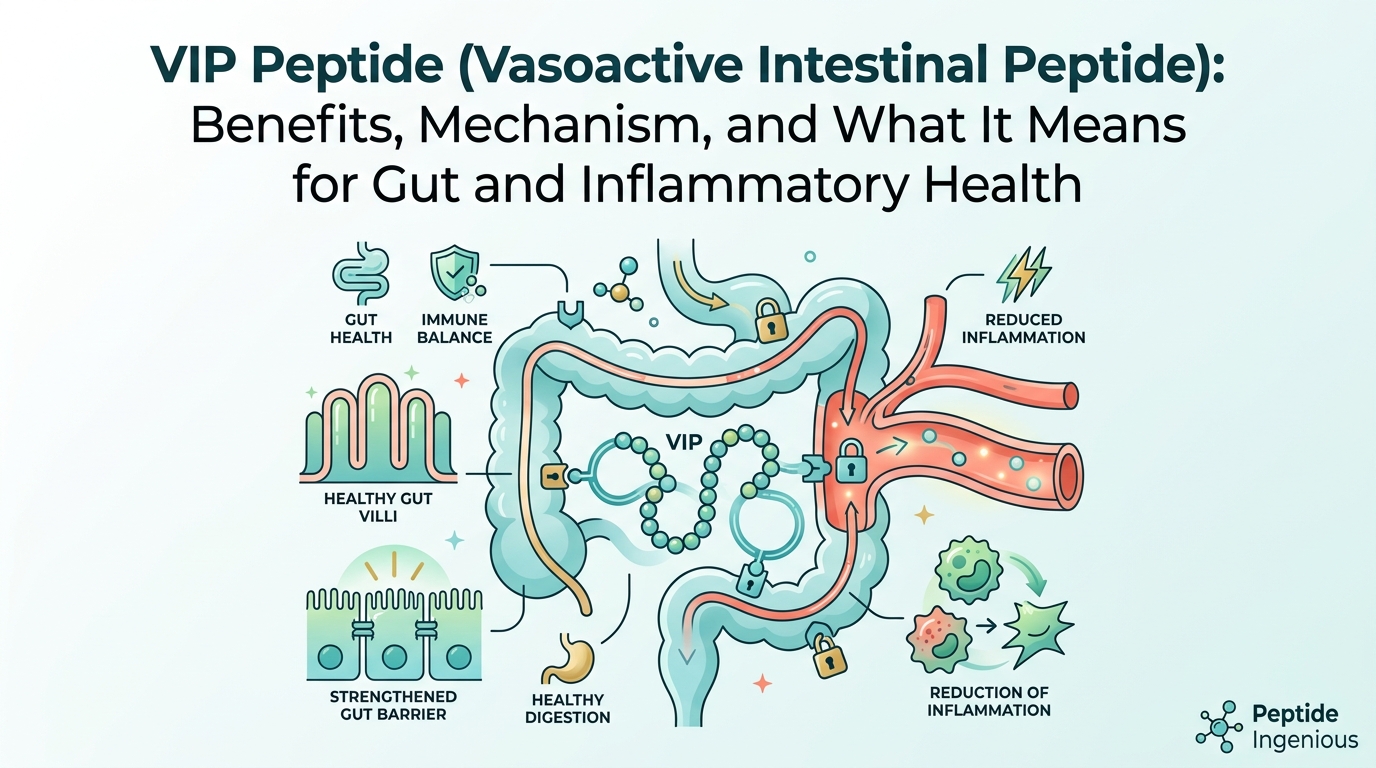
VIP Peptide: Benefits, Mechanism, and What It Means for Gut and Inflammatory Health
October 1, 2026
- Introduction
- What Is VIP Peptide?
- What Does VIP Peptide Do?
- What Is VIP Peptide Used For?
- What Are the Potential VIP Peptide Benefits?
- Does VIP Peptide Help With Gut Health?
- Is VIP Peptide Anti-Inflammatory?
- What Is VIP Nasal Spray?
- What Are the Benefits of VIP Nasal Spray?
- What Are VIP Nasal Spray Side Effects?
- Is There a VIP Peptide Protocol?
- Is VIP Peptide FDA-Approved?
- Can You Buy VIP Peptide Online?
- Featured Snippet Answer
VIP peptide, or vasoactive intestinal peptide, is a naturally occurring 28-amino-acid neuropeptide that helps regulate gastrointestinal function, blood vessel relaxation, hormone release, and immune signaling. It is produced by nerve cells and other tissues throughout the body, where it communicates through VPAC1 and VPAC2 receptors. Researchers are investigating VIP's potential anti-inflammatory and gastrointestinal applications because of its effects on cellular signaling. However, its established physiological functions do not prove that VIP nasal sprays, injections, or commercially marketed formulations effectively treat inflammatory or digestive disorders.
Introduction
Vasoactive intestinal peptide (VIP) is a naturally occurring signaling molecule involved in several essential processes, including gastrointestinal secretion, intestinal motility, vascular regulation, and communication between the nervous and immune systems. Although it was initially identified for its ability to relax blood vessels, subsequent research has revealed a much broader range of biological functions.
Interest in the VIP peptide has expanded beyond basic physiology. Researchers have investigated its interactions with inflammatory cytokines, immune cells, intestinal epithelial tissue, and signaling pathways associated with inflammatory diseases. These findings have generated interest in its potential therapeutic applications, particularly in gastrointestinal and immune-related research.
VIP nasal spray has also attracted attention in online discussions about peptide-based therapies. However, the existence of a biological mechanism or an experimental formulation does not establish that a commercially marketed nasal spray delivers meaningful clinical benefits. The same distinction applies to injectable VIP preparations.
Understanding VIP requires separating three different subjects: the peptide naturally produced by the human body, pharmaceutical formulations investigated in scientific research, and unapproved products marketed online. These are not interchangeable.
This guide examines how VIP works, what research suggests about its potential benefits, how it affects gut and inflammatory physiology, and what is known about its formulations, safety, and regulatory status in the United States. It also distinguishes established scientific findings from preliminary evidence and claims that remain unverified.
What Is VIP Peptide?
VIP peptide is a 28-amino-acid molecule belonging to the secretin/glucagon peptide superfamily. It is also called vasoactive intestinal polypeptide or, in pharmaceutical research, aviptadil. VIP acts as a chemical messenger, allowing nerve cells and other tissues to coordinate digestive, vascular, endocrine, and immune functions.
The word vasoactive refers to its ability to influence blood vessels, while intestinal reflects where it was initially discovered. The name does not mean that VIP acts exclusively in the intestines. It is widely distributed throughout the central and peripheral nervous systems and is found in the digestive, respiratory, reproductive, and cardiovascular systems.
Where is VIP naturally produced?
VIP is synthesized from a larger precursor protein called prepro-VIP. After enzymatic processing, the mature peptide is released by specialized cells, particularly neurons.
Important sources and locations include:
- Enteric nervous system: Neurons within the gastrointestinal tract release VIP to help coordinate intestinal secretion and motility.
- Central nervous system: VIP-producing neurons participate in neural communication and certain circadian and neuroendocrine processes.
- Peripheral autonomic nerves: VIP is released alongside other neurotransmitters and helps regulate blood vessel activity and glandular secretion.
- Immune system: Certain immune cells, including some T-cell populations, can produce VIP or respond to it.
VIP can function as a neurotransmitter, a neuromodulator, and a neuroendocrine signaling molecule. Its effects depend on where it is released, which receptors are present, and the surrounding physiological conditions.
Is VIP a hormone or a neuropeptide?
VIP is commonly described as both a neuropeptide and a peptide hormone. These descriptions reflect overlapping functions rather than different substances.
As a neuropeptide, it helps neurons communicate with other neurons, smooth muscle cells, and glands. As a hormone-like signaling molecule, it can influence distant or nearby tissues through receptor-mediated activity.
The terms peptide: VIP, vasointestinal peptide, vaso intestinal peptide, and VIP intestinal peptide are commonly encountered variations in searches. They generally refer to vasoactive intestinal peptide rather than distinct biologically established compounds.
Endogenous VIP versus externally administered VIP
There is a fundamental difference between naturally produced VIP and an externally administered product.
| Feature | Endogenous VIP | Externally administered VIP |
|---|---|---|
| Origin | Produced naturally by the body | Manufactured as a peptide preparation |
| Release | Regulated by cells and neural activity | Determined by the formulation and route |
| Exposure | Often localized and biologically regulated | Depends on absorption, distribution, and degradation |
| Physiological role | Participates in normal signaling | Intended to produce an additional pharmacological effect |
| Evidence | Established roles in human physiology | Depends on the specific formulation and clinical research |
The presence of VIP in healthy tissues establishes its physiological importance. It does not, by itself, demonstrate that increasing VIP exposure through a nasal spray or injection improves health.
How Does VIP Peptide Work?
VIP works by binding to specialized cell-surface receptors called VPAC1 and VPAC2. These receptors belong to the class B G-protein-coupled receptor family. Their activation commonly stimulates cyclic AMP signaling, although the resulting biological response varies with the tissue and cellular environment.
1. VIP binds to VPAC1 and VPAC2 receptors
The two principal receptors for VIP are:
- VPAC1: Widely expressed in the gastrointestinal tract, including epithelial and immune cells, and in several other tissues.
- VPAC2: Prominent in smooth muscle and vascular tissues, with expression also reported in immune and endocrine cells.
Both receptors respond to VIP and to another related neuropeptide, pituitary adenylate cyclase-activating polypeptide (PACAP). Their distribution and relative activity help determine the effects of VIP in different organs.
Receptor expression is not uniform. It can change with cell type, tissue location, inflammation, and other biological conditions. Consequently, activating VPAC1 in intestinal epithelial cells may produce a different response from activating VPAC2 in vascular smooth muscle.
2. Receptor activation stimulates cAMP signaling
When VIP binds to a compatible VPAC receptor, it can activate a stimulatory G protein known as Gs. This protein stimulates adenylyl cyclase, an enzyme that converts ATP into cyclic AMP, commonly abbreviated as cAMP.
The resulting signaling sequence can be summarized as follows:
- VIP binds to VPAC1 or VPAC2
- G-protein activation (commonly Gs)
- Adenylyl cyclase activation
- Increased intracellular cAMP
- PKA activation
- Protein kinase A
- EPAC signaling
- cAMP-regulated exchange proteins
Downstream effects depend on the cell and its signaling environment.
Two important downstream pathways are protein kinase A (PKA) and exchange proteins directly activated by cAMP (EPAC). These pathways influence cellular processes such as ion transport, secretion, muscle contraction, and gene expression.
Not every VIP response is explained by one pathway. Receptor coupling and downstream signaling can differ between cells, and additional pathways may contribute to particular biological effects.
3. VIP influences intestinal secretion
In the intestine, VIP released by enteric neurons can activate VPAC1 on epithelial cells. The resulting cAMP signaling stimulates ion transport, including chloride and bicarbonate secretion.
Water follows the movement of electrolytes, helping regulate intestinal fluid secretion. VIP also participates in the secretion of protective bicarbonate in the upper gastrointestinal tract.
These effects are part of normal digestive physiology. However, excessive VIP activity can increase fluid secretion substantially, which explains why VIP-producing tumors may cause severe watery diarrhea.
4. VIP regulates smooth muscle and blood vessels
VIP can relax smooth muscle, including gastrointestinal and vascular smooth muscle. In blood vessels, its actions contribute to vasodilation, meaning that the vessels widen and vascular resistance can decrease.
The resulting effects on circulation depend on the location, intensity, and duration of VIP activity. Systemic exposure can produce different effects from localized release by nerves within a tissue.
5. VIP affects immune signaling
VIP also influences immune-cell activity through VPAC receptors and intracellular signaling pathways. Experimental studies have associated VIP signaling with changes in cytokine production, T-cell differentiation, macrophage activity, and regulatory immune responses.
These effects are context-dependent. VIP can influence different immune populations in different ways, and the same signaling pathway may have different consequences depending on the tissue and inflammatory environment.
The central point is that VIP is a multifunctional signaling molecule, not a single-purpose anti-inflammatory agent.
What Does VIP Peptide Do in the Body?
Naturally occurring VIP coordinates several functions that help maintain normal physiological activity. Its effects extend beyond digestion because VIP receptors and VIP-producing neurons are distributed across multiple organ systems.
Gastrointestinal secretion
VIP promotes intestinal electrolyte and fluid secretion and contributes to protective bicarbonate secretion. These functions support the normal chemical environment of the gastrointestinal tract.
Gastrointestinal motility
VIP helps coordinate intestinal muscle activity through interactions with enteric neurons and smooth muscle. Depending on the tissue and circuit involved, its effects may include muscle relaxation and changes in transit.
Vascular regulation
VIP promotes vasodilation, helping regulate local blood flow. When VIP activity is systemic, vascular relaxation can also influence blood pressure.
Neural and neuroendocrine signaling
VIP participates in communication between neurons and influences certain hormone-related processes. It is also involved in some neural pathways associated with circadian rhythms.
Immune regulation
VIP can influence the activity of macrophages and T cells, as well as the release of inflammatory mediators. Its role is regulatory rather than simply stimulating or suppressing the entire immune system.
These functions explain why researchers investigate VIP in gastrointestinal, vascular, and inflammatory conditions. However, asking what VIP does naturally is different from asking what an administered VIP product can accomplish.
For example, VIP's normal involvement in intestinal secretion does not establish that an external VIP preparation improves digestion. Similarly, its participation in immune regulation does not demonstrate that administering VIP treats autoimmune disease.
VIP Peptide Benefits: What Does the Research Suggest?
VIP peptide benefits are an active subject of biomedical research, particularly in gastrointestinal physiology and immune regulation. The strongest evidence concerns VIP's normal biological functions. Potential therapeutic benefits involving inflammation, intestinal barrier integrity, and chronic disease are supported to varying degrees by laboratory, animal, and limited human research.
The distinction between these evidence categories is essential when evaluating claims about VIP.
1. Established physiological roles
Research firmly establishes that naturally occurring VIP participates in:
- Intestinal electrolyte and fluid secretion.
- Regulation of gastrointestinal smooth muscle.
- Vascular relaxation and blood flow.
- Neural and neuroendocrine communication.
- Regulation of selected immune responses.
These functions are supported by physiological research. They do not establish the effectiveness of externally administered VIP for treating digestive or inflammatory conditions.
2. Potential anti-inflammatory effects
Laboratory and animal studies suggest that VIP can influence inflammatory signaling. Researchers have investigated its effects on tumor necrosis factor alpha (TNF-α), interleukins such as IL-6 and IL-12, and other mediators involved in immune responses.
Some experimental findings indicate that VIP signaling can reduce certain pro-inflammatory responses, promote regulatory T-cell activity, and influence the balance between different T-helper-cell populations.
However, these effects vary according to receptor activity, tissue, experimental model, and disease context. An anti-inflammatory response observed in cultured cells does not necessarily predict a beneficial outcome in people with chronic inflammatory disease.
3. Potential immune-modulating effects
VIP has been investigated as an immunomodulatory molecule, meaning that it can alter immune activity rather than simply increase or decrease it.
Research has examined its interactions with macrophages, T cells, dendritic cells, and cytokine networks. Experimental work suggests that VIP may influence immune tolerance and help regulate excessive inflammatory responses under certain conditions.
The same complexity also creates uncertainty. Modifying one immune pathway may have different consequences in different diseases. VIP should therefore not be characterized as a universal immune booster or an established immune-suppressing treatment.
4. Potential effects on intestinal barrier function
The intestinal barrier is the collection of epithelial cells and associated structures that separates the intestinal contents from underlying tissues. Tight junction proteins help control movement between neighboring epithelial cells.
Research has linked VIP signaling with changes in tight junction proteins, including zonula occludens-1 (ZO-1), occludin, and claudins. Laboratory and animal findings suggest that VIP-related pathways can influence epithelial permeability and responses to intestinal inflammation.
Some experimental studies report preservation of barrier-related features under specific inflammatory or infectious conditions. However, these findings cannot be generalized to claims that VIP administration repairs human intestinal permeability or treats so-called leaky gut.
5. Other proposed therapeutic applications
VIP and its receptor pathways have been studied in several additional areas, including pulmonary vascular disease, neurological conditions, and autoimmune inflammation.
For example, small human studies have investigated inhaled VIP in pulmonary hypertension, while intravenous aviptadil has been studied in critically ill patients with respiratory failure. These investigations demonstrate that VIP has been administered in clinical research, not that it is an established treatment for those conditions.
What the evidence means
VIP has established physiological functions and scientifically plausible therapeutic mechanisms. However, the existence of these mechanisms does not prove that VIP nasal sprays or injections provide meaningful benefits for gut health, chronic inflammation, or immune disorders.
VIP Peptide and Gut Health
VIP plays a substantial role in gastrointestinal physiology, particularly in intestinal secretion, smooth muscle regulation, and communication between enteric nerves and intestinal tissues. Research also suggests that VIP signaling is involved in intestinal barrier regulation and mucosal immune responses.
VIP in the enteric nervous system
The enteric nervous system is a network of neurons located within the gastrointestinal tract. It coordinates many digestive functions independently of direct moment-to-moment instructions from the brain.
VIP is one of the neuropeptides released by enteric neurons. It helps coordinate signaling between nerve cells, intestinal epithelial cells, and smooth muscle.
This local signaling contributes to digestive functions such as fluid secretion, intestinal movement, and the regulation of the intestinal environment.
VIP and intestinal secretion
One of VIP's best-characterized gastrointestinal functions is stimulating intestinal electrolyte secretion.
VIP activates VPAC1-associated signaling in epithelial cells, increasing intracellular cAMP and influencing ion transport. Chloride and bicarbonate secretion contribute to fluid movement into the intestinal lumen.
This process is necessary for normal gastrointestinal physiology, but excessive VIP activity can have the opposite of a desirable effect. For example, VIP-producing neuroendocrine tumors, known as VIPomas, can cause profuse watery diarrhea and significant fluid and electrolyte loss.
This illustrates why the physiological activity of a peptide cannot automatically be interpreted as a health benefit when its exposure is increased.
VIP and gastrointestinal motility
VIP participates in the neural control of gastrointestinal smooth muscle. Its effects depend on the specific muscle, receptor distribution, and surrounding neural activity.
In some tissues, VIP contributes to relaxation. In others, its effects on enteric circuits can influence coordinated intestinal movement. These interactions help regulate the timing and movement of gastrointestinal contents.
However, altered VIP signaling is not, by itself, proof that increasing VIP will correct a particular motility disorder.
VIP and the intestinal barrier
The intestinal epithelial barrier protects underlying tissue while allowing controlled absorption and secretion. Tight junction proteins help maintain this selective permeability.
Experimental studies have linked VIP signaling to tight junction regulation and intestinal epithelial integrity. Some animal models suggest that VIP-related pathways may influence the severity of intestinal injury and inflammatory changes.
The evidence is not uniform across intestinal regions or experimental models. Furthermore, changes in laboratory measures of epithelial permeability do not establish that an administered VIP product improves symptoms or clinical outcomes in people.
VIP and inflammatory bowel conditions
Research has investigated VIP in Crohn's disease and ulcerative colitis. Observational studies have reported altered VIP levels in some patients, while experimental colitis models have produced differing results depending on the model and the conditions of the experiment.
Some animal studies suggest protective effects, while others have reported worsening inflammation following particular VIP interventions. These differences may reflect receptor-specific actions, the timing of exposure, dose-related effects, and differences between experimental models.
Consequently, VIP is a subject of research in intestinal inflammation, not an established treatment for inflammatory bowel disease. It should not be presented as a proven therapy for irritable bowel syndrome, Crohn's disease, ulcerative colitis, or intestinal permeability disorders.
VIP Peptide and Inflammatory Health
VIP has been studied extensively as a neuroimmune signaling molecule because it can influence immune cells and inflammatory mediators. Experimental research supports several immunomodulatory mechanisms, but clinical evidence is not sufficient to establish VIP as a general treatment for chronic inflammation or autoimmune disease.
Neuroimmune communication
The nervous and immune systems communicate through chemical messengers, including neuropeptides such as VIP.
VIP released from nerves can interact with immune cells through VPAC receptors. In the gastrointestinal tract, this interaction helps connect neural activity with mucosal immune responses. Similar signaling relationships have been investigated in other organs.
Neuroimmune signaling is particularly relevant because inflammation can affect nerve activity, while neural mediators can influence the behavior of immune cells. VIP is one component of this complex two-way relationship.
VIP and inflammatory cytokines
Cytokines are signaling proteins that help coordinate immune activity. Some cytokines promote inflammation, while others contribute to its regulation and resolution.
In experimental systems, VIP has been associated with changes in cytokines such as:
- TNF-α: A major mediator of inflammation that can influence tissue injury and epithelial barrier function.
- IL-6: A cytokine involved in immune responses, acute inflammation, and several chronic inflammatory processes.
- IL-12: A cytokine involved in the development of certain T-cell responses.
- IL-10: An important regulatory cytokine that can limit selected inflammatory responses.
Studies have reported that VIP signaling can reduce some pro-inflammatory mediators and increase regulatory responses in particular experimental settings.
These findings are biologically relevant, but the effect of a peptide on cytokines in an experimental system is not equivalent to a demonstrated improvement in disease symptoms, complications, or long-term outcomes.
VIP and immune-cell differentiation
Research has investigated VIP's influence on different T-helper-cell populations, including Th1, Th2, and Th17 cells, as well as regulatory T cells.
Some experimental findings associate VIP signaling with reduced Th1 and Th17 activity and increased regulatory or Th2-associated responses. Macrophage activity and innate immune signaling have also been investigated.
These effects are not universal. The biological consequences depend on the cells involved, their activation state, receptor expression, and the inflammatory environment. In addition, immune pathways that are beneficial in one context may not be desirable in another.
Research involving inflammatory diseases
Researchers have investigated VIP-related pathways in experimental models of conditions such as inflammatory bowel disease, rheumatoid arthritis, and neurological inflammation.
There is also clinical research involving VIP in pulmonary and respiratory disease. However, evidence from these different conditions cannot be combined into a general claim that VIP treats inflammation.
The clinical relevance of an experimental immune effect must be established separately for each condition, formulation, route, and patient population.
Why anti-inflammatory claims need context
VIP may suppress selected inflammatory signals in one experimental setting while producing different effects in another. Describing it simply as an anti-inflammatory peptide leaves out the receptor, tissue, disease, and clinical factors that determine its actual effects.
What Is VIP Nasal Spray?
VIP nasal spray refers to a formulation intended to deliver vasoactive intestinal peptide through the nasal passages. Intranasal delivery is an area of pharmaceutical research, but the existence of a nasal formulation does not establish its absorption, clinical effectiveness, or safety for a particular condition.
Why investigate intranasal VIP?
The nasal route is studied for certain medicines because the nasal lining contains blood vessels and can absorb some substances. Depending on the formulation and molecule, intranasal delivery may provide a non-injectable route of administration.
For peptides, however, delivery is challenging. Peptides can be degraded by enzymes, have limited membrane permeability, and exhibit variable absorption. The extent to which a particular peptide reaches the circulation or a target tissue depends on its formulation and pharmacokinetic properties.
VIP's naturally occurring activity does not establish that a nasal spray can reproduce the precise timing, concentration, or tissue distribution of endogenous release.
What happens after intranasal administration?
The pharmacological behavior of a nasal peptide depends on several factors:
- Peptide stability in the formulation and nasal environment.
- Absorption through the nasal mucosa.
- Enzymatic degradation.
- Local distribution and possible systemic exposure.
- The characteristics of the delivery system.
- The biological activity retained after delivery.
These factors must be investigated for the specific formulation. Results from a study using one aerosol or nasal preparation cannot automatically be applied to a different product.
Is VIP nasal spray supported by human research?
There is human research involving VIP in the respiratory and nasal settings, but the studies have examined different questions.
A 1990 study investigated naturally occurring VIP in human nasal tissue. It identified VIP-containing nerve fibers and examined its effects on secretion in nasal tissue samples. This was a study of nasal physiology, not evidence that a commercial VIP nasal spray treats inflammatory or gastrointestinal disorders.
A separate randomized study involving 12 healthy volunteers investigated the intranasal effects of exogenous VIP and other neuropeptides in the context of enzyme inhibition. Its small sample and specific experimental design do not establish the effectiveness of commercially marketed nasal sprays for chronic conditions.
Research on inhaled VIP in pulmonary disease also should not be confused with evidence for an ordinary nasal spray. Inhalation into the lungs and delivery through the nasal passages are different routes with different delivery characteristics.
Research formulations versus commercial products
A pharmaceutical formulation used in a clinical trial is prepared and evaluated for a particular research purpose. A commercially marketed product may have different ingredients, stability, concentration, packaging, and quality controls.
The name VIP nasal spray does not establish that two products are equivalent. Nor does a product description establish that a formulation has undergone appropriate clinical testing.
The terms vip spray, vip spray nasal, vasoactive intestinal peptide nasal spray, and vasoactive intestinal polypeptide nasal spray are search variations that may refer to different products or research concepts. They should not be treated as evidence of interchangeable formulations.
VIP Nasal Spray Benefits: What Is Actually Supported?
The proposed benefits of VIP nasal spray are often based on VIP's physiological and experimental properties. However, evidence for the natural peptide, evidence from laboratory studies, and evidence for a particular intranasal formulation are three different things.
The scientific rationale for investigating intranasal VIP includes its biological activity and the possibility of non-injectable delivery. Yet the route itself introduces questions about absorption, stability, and the relationship between the amount administered and the resulting biological response.
What does human research establish?
Human research has examined VIP in different contexts, including inhaled delivery for pulmonary vascular disease and experimental intranasal exposure. Some small studies have demonstrated measurable short-term physiological effects.
For example, a study of 20 patients with pulmonary hypertension evaluated a single inhaled dose of aviptadil. It found modest, temporary pulmonary vasodilation. The study was small, examined an inhaled formulation, and was not a trial of a commercially marketed VIP nasal spray for gut health or chronic inflammation.
Such findings establish that administered VIP can produce measurable physiological effects under particular research conditions. They do not establish a general benefit for nasal sprays.
What about gut health and inflammation claims?
The proposed VIP nasal spray benefits discussed online sometimes include improved intestinal health, reduced inflammation, and immune regulation. These claims require controlled clinical evidence involving the exact formulation and intended use.
Mechanistic findings about VPAC receptors or cytokines are insufficient to establish those outcomes. Evidence from inhaled formulations also cannot be assumed to demonstrate nasal efficacy.
Why testimonials are insufficient
Personal accounts may describe experiences with a product, but they cannot reliably establish its efficacy. Testimonials generally lack control groups, standardized outcome measurements, and the ability to separate treatment effects from other influences.
For these reasons, claims about VIP nasal spray benefits should be evaluated against formulation-specific clinical research, rather than inferred from VIP's biological functions or individual reports.
VIP Nasal Spray Side Effects and Safety
The safety of VIP nasal spray depends on its formulation, exposure, route of administration, and the population receiving it. VIP's established physiological effects raise potential concerns involving blood pressure and gastrointestinal function, while the available clinical evidence does not establish a comprehensive safety profile for long-term intranasal use.
Potential cardiovascular effects
VIP is a vasodilator, meaning it can relax blood vessels. Systemic exposure may lower vascular resistance and affect blood pressure. The extent of these effects depends on exposure and the physiological setting.
Hypotension is a documented concern with administered VIP. However, its frequency and severity cannot be generalized across all formulations and routes.
In a randomized trial of intravenous aviptadil in critically ill patients with COVID-19, hypotension occurred in both the treatment and placebo groups, without a statistically significant difference between them. This finding applies to that specific study population and treatment setting; it does not establish the cardiovascular safety of unregulated nasal products.
Gastrointestinal effects
VIP stimulates intestinal electrolyte and fluid secretion. Excessive endogenous VIP activity, particularly in VIP-secreting tumors, can cause severe watery diarrhea.
Diarrhea has also been documented in human research involving administered VIP. In the intravenous aviptadil trial involving critically ill patients, mild-to-moderate diarrhea occurred more frequently in the treatment group than in the placebo group.
These observations establish a potential gastrointestinal concern, but they do not provide a reliable estimate of the risk associated with every intranasal formulation.
Intranasal formulation considerations
A nasal product introduces additional uncertainties, including local tolerability, formulation stability, absorption variability, and potential exposure to inactive ingredients or contaminants.
The safety of a nasal spray used in a controlled clinical study cannot automatically be applied to products with different ingredients, manufacturing processes, or quality standards.
Long-term safety remains uncertain
Short-term physiological studies do not establish long-term safety. Repeated exposure could produce different effects from those observed after a single administration, and adequate long-term data may not exist for a particular formulation or intended use.
Documented versus potential risks
Diarrhea and blood-pressure effects are supported by human evidence involving administered VIP. Other risks associated with particular nasal products must be assessed individually. A complete, formulation-independent adverse-effect profile cannot be assumed from the available research.
VIP Peptide Protocol: What Should You Know?
A VIP peptide protocol generally refers to a set of instructions describing how an experimental or compounded VIP product is used. Online protocols may differ substantially from clinical research procedures, and they should not be treated as validated treatment guidelines.
Clinical research protocols versus online recommendations
Clinical research protocols are designed around a defined study question. They specify the investigational product, population, route, monitoring requirements, outcome measures, and safety procedures.
Online VIP peptide protocols may instead be based on anecdotal experiences, practitioner-specific approaches, or interpretations of studies that investigated a different formulation or disease.
A research protocol is not a general prescription. Its findings apply primarily to the conditions under which the study was conducted.
Why formulation and clinical context matter
The pharmacological behavior of VIP depends on several variables:
- The formulation and its stability.
- The route of administration.
- The amount of systemic exposure.
- The condition being investigated.
- The population included in the research.
- The duration and nature of clinical monitoring.
A protocol evaluated for an inhaled formulation in a pulmonary study cannot automatically be transferred to an intranasal spray or injectable preparation.
What about VIP peptide injection protocols?
Searching for a VIP peptide injection protocol may produce schedules and instructions that are not supported by controlled clinical evidence. Such information should not be mistaken for a standardized treatment regimen.
There is no universally validated self-treatment protocol for VIP nasal sprays or injections. The existence of an online protocol does not establish its safety, effectiveness, or suitability for a particular condition.
For this reason, this article does not provide doses, injection schedules, reconstitution instructions, or treatment cycles.
VIP Peptide Injections vs. Nasal Spray
VIP injections and nasal sprays are different delivery approaches. They can produce different exposure patterns, and evidence from one route does not establish the effectiveness or safety of the other.
Injectable VIP has been investigated in clinical research, including intravenous studies of aviptadil. Inhaled VIP has also been examined in pulmonary research. These investigations do not validate every injectable or nasal product sold under the VIP name.
| Feature | VIP Injection | VIP Nasal Spray |
|---|---|---|
| Administration route | Injectable | Intranasal |
| Delivery considerations | Formulation, absorption, and systemic exposure depend on the injection route | Nasal absorption and peptide stability are formulation-dependent |
| Pharmacokinetic evidence | Must be evaluated for the specific formulation | Must be evaluated for the specific formulation |
| Clinical evidence | Human studies exist for certain investigational formulations and indications | Limited, route-specific human research; commercial claims require separate verification |
| Safety considerations | Systemic cardiovascular and gastrointestinal effects may be relevant | Potential systemic effects and formulation-specific nasal tolerability require evaluation |
| Regulatory status | No FDA-approved human VIP drug product established | No FDA-approved human VIP nasal spray established |
| Established self-treatment protocol | No universally validated protocol | No universally validated protocol |
Differences in pharmacokinetics
Pharmacokinetics describes how a substance is absorbed, distributed, metabolized, and eliminated.
An injectable preparation may provide systemic exposure that differs substantially from an intranasal preparation. Nasal absorption can be influenced by the formulation and the condition of the nasal mucosa, while peptide degradation may limit the amount of active substance that reaches the circulation.
These differences are particularly important for VIP because its biological effects can be influenced by exposure, receptor distribution, and the tissue receiving the signal.
Do injections or nasal sprays have established advantages?
It is not scientifically justified to declare one route more effective or safer for general VIP use without appropriate comparative clinical studies.
Research findings for one formulation should remain specific to that formulation and route. Neither an injectable product nor a nasal spray should be assumed to provide established benefits for gut health or inflammatory disease.
Is VIP Peptide FDA-Approved?
As of October 1, 2026, the FDA does not have an approved human drug product containing VIP for a specific medical indication. However, FDA's compounding policies distinguish between drug approval and certain limited circumstances in which a pharmacy may compound a preparation.
FDA approval versus clinical research
FDA approval means that the agency has evaluated a particular drug product for a defined indication and determined that it meets applicable standards for approval.
A clinical trial is different. It investigates a product's safety, effectiveness, or other characteristics under a research protocol. Investigational use does not authorize general commercial marketing as an approved drug.
Similarly, orphan drug designation, investigational drug status, or a substance's presence in an FDA database does not, on its own, establish approval.
What is the status of VIP in compounding?
VIP has appeared in FDA's Category 1 interim list of bulk drug substances under consideration for certain section 503A compounding circumstances. Category 1 placement is associated with conditional FDA enforcement discretion while evaluation proceeds. It is not FDA approval of VIP as a medication, nor does it mean every preparation or intended use is automatically lawful.
Compounding must satisfy the applicable statutory and regulatory requirements, including requirements relating to prescriptions, ingredients, and the circumstances in which a compounded drug may be prepared. A product's legal status depends on the actual preparation and applicable rules, not simply its name or availability.
Does FDA approval cover VIP nasal spray?
The existence of a nasal formulation, a research study, or a compounded preparation does not establish FDA approval for a commercial VIP nasal spray. Approval is product-specific and indication-specific.
Readers should distinguish among FDA-approved medicines, investigational formulations, compounded preparations, and products marketed online. These categories have different regulatory implications.
Can You Buy VIP Peptide?
Searching for VIP peptide for sale may return research chemicals, investigational products, and preparations marketed for other purposes. However, a commercial listing does not establish FDA approval, product quality, or suitability for human administration.
Understanding the different product categories
| Product category | What it means | What it does not establish |
|---|---|---|
| FDA-approved medication | A specific drug product has received FDA approval for defined uses | Approval of every formulation containing a related substance |
| Investigational product | A product is being evaluated in clinical research | General permission to market it as an approved treatment |
| Compounded preparation | A pharmacy prepares a medication under applicable compounding requirements | FDA approval or demonstrated efficacy for every intended use |
| Research-use product | A product is marketed for laboratory or other research purposes | Suitability or authorization for human treatment |
| Online commercial listing | A seller advertises a product | Verified identity, purity, sterility, or clinical effectiveness |
Why product quality matters
Peptides are sensitive to manufacturing and storage conditions. Identity, purity, stability, and contamination control can all affect the quality of a preparation.
An online certificate of analysis or a seller's description is not equivalent to independent regulatory approval. Nor does a research-use label make a product appropriate for human administration.
For anyone evaluating information about VIP products, the central questions are whether the specific formulation has credible quality documentation, whether its regulatory status is clear, and whether the claims being made are supported by relevant clinical evidence.
What Does the Evidence Actually Support?
The evidence supports VIP's role in normal gastrointestinal, vascular, neural, and immune physiology. Experimental studies also identify potential therapeutic mechanisms, but evidence for treating human gastrointestinal and inflammatory diseases remains limited and depends on the specific application.
The distinction between biological activity and clinical effectiveness is central to interpreting the research.
| Area | Evidence base | What is supported | Main limitation |
|---|---|---|---|
| Natural VIP physiology | Established physiological research | Roles in neural signaling, secretion, motility, and vascular regulation | Does not prove benefits from external administration |
| Gastrointestinal signaling | Physiological and mechanistic research | Effects on intestinal secretion and smooth muscle | Disease-treatment effects require separate clinical evidence |
| Inflammatory signaling | Mechanistic and preclinical research | Potential immunomodulatory pathways | Effects vary by tissue, receptor, and disease |
| Gut barrier research | Cell-based and animal studies | VIP-associated changes in epithelial barrier function | Human treatment outcomes remain uncertain |
| VIP nasal spray | Limited, formulation-specific research | Some human experimental work on intranasal VIP and nasal physiology | Does not establish commercial spray effectiveness |
| VIP inhalation | Small human studies and clinical trials | Measurable physiological effects in certain settings | Findings are specific to the formulation and condition |
| VIP injections | Human research involving selected formulations | Some physiological and clinical outcomes have been investigated | Results cannot be generalized to other preparations or indications |
| Long-term therapeutic use | Limited, indication-dependent evidence | No general conclusion of long-term effectiveness or safety | Long-term outcomes remain uncertain for many proposed uses |
What human studies tell us
Human research has investigated VIP in respiratory disease, pulmonary vascular conditions, and other specialized settings. However, these studies vary in design, sample size, formulation, route, and clinical objectives.
For instance, an early inhalation study in 20 patients with pulmonary hypertension found a modest, temporary improvement in selected pulmonary hemodynamic measurements after a single administration. It was not a long-term treatment trial and did not evaluate a commercially marketed nasal spray.
Intravenous aviptadil has also been studied in critically ill patients with COVID-19. Although an earlier randomized trial reported some promising secondary findings, its primary outcome limitations and the uncertainty surrounding the results prevent it from establishing a general therapeutic benefit. The results are not evidence for treating chronic inflammatory or gastrointestinal conditions with VIP nasal spray.
What remains uncertain?
Several important questions remain unresolved:
- Whether externally administered VIP can produce reliable clinical benefits for common gastrointestinal disorders.
- Whether intranasal formulations can deliver consistent and clinically meaningful exposure.
- Which immune effects, if any, translate into beneficial human outcomes for specific inflammatory diseases.
- How different formulations compare in terms of pharmacokinetics and safety.
- What the long-term consequences of repeated administration might be for particular indications.
The available evidence supports continued scientific investigation. It does not justify treating VIP as a proven general therapy for gut health, immune dysfunction, or chronic inflammation.
Responsible Scientific Communication for Peptide Brands
Peptide-related content often involves complex distinctions between biological mechanisms, experimental findings, clinical outcomes, and regulatory requirements. Communicating those distinctions accurately is important for readers evaluating claims about products and potential medical applications.
Peptide brands publishing educational material can benefit from clear scientific explanations, appropriately qualified claims, and transparent regulatory information.
Peptide Ingenious provides digital services to peptide brands, including peptide-specific SEO and AEO, compliant website development, conversion rate optimization, compliance monitoring, and email retention marketing.
Scientific content and digital marketing should not imply that an experimental peptide has demonstrated clinical benefits when the supporting evidence is preliminary or incomplete. Clear communication helps readers distinguish educational information from product promotion and medical advice.
FAQs (Frequently Asked Questions)
What Is VIP Peptide?
VIP peptide, or vasoactive intestinal peptide, is a naturally occurring 28-amino-acid neuropeptide. It is involved in gastrointestinal secretion, smooth muscle regulation, blood vessel relaxation, neural communication, and immune signaling. VIP also serves as the basis for experimental therapeutic research, but its normal biological functions do not establish the effectiveness of externally administered formulations.
What Does VIP Peptide Do?
VIP helps regulate intestinal fluid and electrolyte secretion, gastrointestinal muscle activity, and vascular tone. It also participates in communication between the nervous and immune systems. Its effects depend on VPAC1 and VPAC2 receptor activity and the tissue involved. The effects of naturally produced VIP should not be confused with the clinical effects of an administered VIP product.
What Is VIP Peptide Used For?
Naturally occurring VIP helps maintain normal physiological functions, including digestion, vascular regulation, and immune signaling. Pharmaceutical formulations have been investigated in clinical research involving conditions such as pulmonary vascular disease and respiratory failure. These investigations do not establish a general FDA-approved medical use for VIP, and experimental research should not be interpreted as a treatment recommendation.
What Are the Potential VIP Peptide Benefits?
Research has identified VIP's roles in gastrointestinal regulation, vascular relaxation, and immune signaling. Laboratory and animal studies suggest potential effects on inflammatory pathways and intestinal barrier function. However, evidence for treating human digestive or inflammatory diseases remains limited. Potential biological benefits should not be confused with proven clinical benefits from nasal sprays or injections.
Does VIP Peptide Help With Gut Health?
VIP is naturally involved in intestinal secretion, gastrointestinal motility, and neuroimmune communication. Experimental studies also suggest that VIP signaling can influence intestinal epithelial barrier function. These findings establish its biological relevance to gut physiology, but they do not demonstrate that administering VIP effectively treats irritable bowel syndrome, inflammatory bowel disease, or intestinal permeability disorders.
Is VIP Peptide Anti-Inflammatory?
VIP has demonstrated anti-inflammatory effects in several experimental models, including changes in selected cytokines and immune-cell activity. However, its effects are context-dependent and can differ by receptor, tissue, and disease. It is more accurately described as an immunomodulatory peptide than as a universally anti-inflammatory treatment. Clinical evidence does not establish it as a general therapy for chronic inflammation.
What Is VIP Nasal Spray?
VIP nasal spray is a formulation intended to deliver vasoactive intestinal peptide through the nasal passages. Intranasal delivery has been investigated experimentally, but formulations differ in stability, absorption, and pharmacological characteristics. Evidence from natural VIP physiology or inhaled VIP research cannot automatically establish the effectiveness or safety of a commercially marketed nasal spray.
What Are the Benefits of VIP Nasal Spray?
The proposed benefits of VIP nasal spray are based largely on the biological functions of VIP and the rationale for intranasal peptide delivery. Some human studies have investigated intranasal VIP under specific experimental conditions. However, reliable clinical evidence does not establish broadly marketed VIP nasal sprays as effective treatments for gut disorders, chronic inflammation, or immune dysfunction.
What Are VIP Nasal Spray Side Effects?
Human research involving administered VIP has documented gastrointestinal effects, including diarrhea, and has identified blood-pressure effects as a relevant safety consideration. The specific risks of an intranasal preparation depend on its formulation and exposure. A comprehensive adverse-effect profile for commercially marketed VIP nasal sprays cannot be assumed, particularly where long-term safety data are unavailable.
Is There a VIP Peptide Protocol?
There is no universally validated self-treatment protocol for VIP nasal sprays or injections. Clinical research protocols are designed for particular formulations, populations, and medical questions. Online instructions may not reflect those conditions and should not be considered validated medical guidance. The existence of a published research protocol does not establish that it is appropriate for general use.
Is VIP Peptide FDA-Approved?
As of October 1, 2026, there is no FDA-approved human drug product containing VIP for a specific medical indication. VIP's presence in certain FDA compounding policy categories does not constitute drug approval. Clinical investigation, compounding eligibility, commercial availability, and FDA approval are distinct regulatory concepts and should not be treated as interchangeable.
Can You Buy VIP Peptide Online?
Online listings may advertise VIP as a research product or another type of preparation, but a listing does not establish FDA approval, purity, sterility, or suitability for human use. Research products, investigational formulations, and compounded preparations have different regulatory and quality requirements. Commercial availability alone does not demonstrate clinical effectiveness or establish that a product is appropriate for treatment.
Featured Snippet Answer
VIP peptide, or vasoactive intestinal peptide, is a naturally occurring neuropeptide that regulates intestinal secretion, smooth muscle activity, blood vessel relaxation, and immune signaling. It acts primarily through VPAC1 and VPAC2 receptors. Although researchers are investigating its potential anti-inflammatory and gastrointestinal applications, evidence does not establish VIP nasal sprays or injections as general treatments for these conditions.
Medical Disclaimer
This article is for educational and informational purposes only. It is not medical advice, a diagnosis, or a recommendation to use VIP peptide, nasal sprays, injections, or other peptide formulations. Experimental findings and physiological mechanisms do not establish treatment effectiveness. Consult a qualified healthcare professional regarding medical conditions, treatment decisions, and questions about medication safety. Unapproved or unregulated peptide products may carry risks that are not adequately characterized by available research.