KPV: The Anti-Inflammatory Tripeptide for Gut and Skin
September 30, 2026
- Introduction
- What Is KPV Peptide?
- What Does KPV Do?
- KPV for Skin Health: What Does the Science Say?
- Oral KPV, KPV Capsules, and Supplements
- KPV Peptide Side Effects and Safety
- Is KPV FDA-Approved?
- What Is KPV Peptide?
- What Does KPV Do?
- What Are the Benefits of KPV Peptide?
- Can KPV Peptide Support Gut Health?
- Does KPV Help With Skin Inflammation?
- Is Oral KPV Effective?
- Are KPV Capsules Available?
- What Are KPV Peptide Side Effects?
- Can KPV Affect the Liver?
- Is KPV FDA-Approved?
- Is KPV Returning to Compounding Access?
- What Is the Difference Between KPV and KVP?
- What Is KPV Peptide?
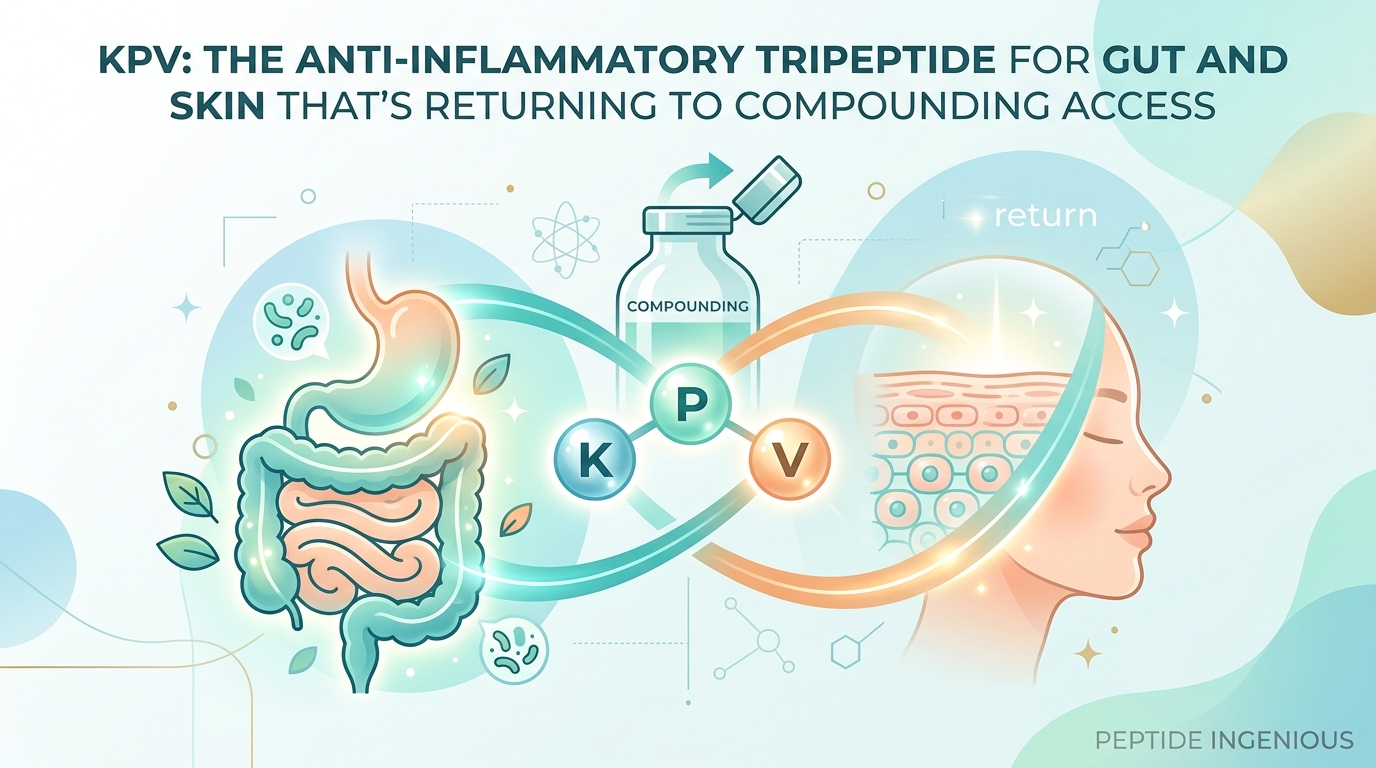
KPV peptide is a three-amino-acid compound made of lysine, proline, and valine. Derived from the C-terminal region of alpha-melanocyte-stimulating hormone (α-MSH), it has shown potential anti-inflammatory activity in laboratory and animal research, particularly involving intestinal inflammation. However, clinical benefits for gut or skin conditions remain unproven. Although the FDA considered KPV for its 503A compounding bulk drug list in July 2026, consideration alone does not establish permission to compound it.
Introduction
KPV peptide has attracted attention in peptide research because of its proposed anti-inflammatory properties and its potential applications in gut and skin health. Unlike larger peptide hormones, KPV consists of only three amino acids. This relatively small structure has made it a subject of research into inflammatory signaling, intestinal delivery, and possible topical applications.
Interest in KPV has grown alongside research into peptides that may influence inflammatory pathways. Early experimental studies have investigated whether KPV can modify inflammatory responses in intestinal cells and animal models of colitis. More recent research has also examined its effects on skin cells exposed to environmental pollutants. These findings have generated scientific interest, but they do not establish that KPV can effectively treat inflammatory diseases in people.
Another reason for renewed attention is the discussion surrounding KPV compounding in the United States. The FDA considered KPV-related substances for inclusion on its 503A bulk drug substances list in July 2026. However, a regulatory review is not the same as authorization, and commercial listings do not establish legal eligibility for pharmacy compounding.
Understanding KPV therefore requires examining three separate questions: what the scientific evidence demonstrates, what remains uncertain about its safety and effectiveness, and what current federal compounding rules actually permit.
What Is KPV Peptide?
KPV is a tripeptide, meaning it is a molecule made up of three amino acids linked together. It is the C-terminal sequence of alpha-melanocyte-stimulating hormone (α-MSH), a naturally occurring peptide involved in several biological processes, including pigmentation and inflammatory regulation.
The three letters in KPV identify its amino acid sequence:
| Letter | Amino acid | Role in the sequence |
|---|---|---|
| K | Lysine | First amino acid |
| P | Proline | Second amino acid |
| V | Valine | Third amino acid |
KPV is also described in scientific literature as α-MSH(11–13), referring to the final three amino acids of the 13-amino-acid α-MSH molecule. It is considerably shorter than the parent hormone, which makes its biological behavior an interesting subject for research.
Although KPV is derived from α-MSH, the two molecules should not be treated as pharmacologically interchangeable. The shorter fragment has demonstrated certain anti-inflammatory effects in experimental settings, but its precise molecular targets remain incompletely understood.
KPV is also distinct from KVP, KPB, and other similar-looking sequences. Reversing the amino acids changes the molecule, while changing its salt form can affect its chemical and pharmaceutical properties. The FDA specifically evaluated KPV free base and KPV acetate as separate bulk drug substances in 2026.
Search terms such as what is KPV, KPV peptide what is it, k.p.v, and peptide KPV generally refer to the same three-amino-acid sequence, although not every commercial product using those terms necessarily contains an identical, adequately characterized ingredient.
What Does KPV Do?
KPV is being investigated primarily for its potential to influence inflammatory signaling. Laboratory experiments suggest that it can reduce certain inflammatory responses, including signaling involving nuclear factor kappa B (NF-κB) and mitogen-activated protein kinases (MAPKs). Animal research has also examined its effects on experimental intestinal inflammation.
NF-κB is a transcription factor that helps regulate genes involved in inflammation and immune responses. When activated, it can increase the production of inflammatory mediators, including certain cytokines. MAPKs are signaling proteins involved in cellular responses to stress, growth, and inflammation.
Some experiments suggest that KPV can interfere with these pathways and reduce the expression or release of inflammatory mediators. Another proposed mechanism involves PepT1, a transporter that moves certain dipeptides and tripeptides across intestinal cell membranes.
However, researchers have not fully established the molecular targets responsible for KPV's biological effects. Its activity also does not necessarily depend on the same melanocortin receptor mechanisms responsible for many of α-MSH's effects.
These findings help explain why KPV benefits are being investigated in several research areas. They do not establish that the peptide reduces inflammation throughout the human body, improves immune function, or treats inflammatory diseases.
The distinction is important: demonstrating that a molecule changes an inflammatory pathway in cultured cells is an early scientific finding, not proof that taking the molecule improves a medical condition.
KPV Peptide Benefits: What Does Research Suggest?
Potential KPV peptide benefits are primarily based on experimental evidence. The main areas of interest are inflammatory signaling, intestinal inflammation, wound healing, and skin-cell protection. Human clinical benefits have not been established.
Potential Anti-Inflammatory Benefits
Laboratory studies have found that KPV can inhibit certain inflammatory signaling pathways and reduce inflammatory cytokine production. In particular, researchers have investigated its effects on NF-κB and MAPK signaling.
These observations provide a biological rationale for studying KPV as an anti-inflammatory peptide. However, the findings come predominantly from cell experiments and animal models. The effects observed under controlled experimental conditions cannot automatically be translated into a clinically meaningful reduction in inflammation in people.
Potential Gut Health Benefits
Gut health is one of the most extensively investigated areas of KPV research. Experimental studies involving intestinal epithelial cells and mice suggest that KPV may influence inflammatory activity in the intestinal lining.
Some studies have reported reduced intestinal inflammatory markers and less tissue damage in experimental colitis. However, these are preclinical observations, not evidence that KPV treats human inflammatory bowel disease or routinely improves digestive health.
Potential Skin Health Benefits
KPV is also being investigated for its possible effects on skin inflammation and wound healing. Experimental studies have examined its ability to influence inflammatory responses in skin cells and investigated methods of delivering it across skin tissue.
These findings are relevant to future formulation research, but they do not establish that a commercially available KPV cream can improve eczema, psoriasis, acne, or wound healing in patients.
Potential Metabolic Effects
Claims concerning metabolic balance are less firmly supported. Although inflammation and metabolism interact biologically, evidence that KPV influences inflammatory pathways is not sufficient to conclude that it improves glucose regulation, body composition, or metabolic health in humans.
Overall, the potential benefits of KPV remain research questions rather than established medical outcomes.
KPV Peptide for Gut Health
KPV peptide for gut health is a major research topic because of experimental findings involving intestinal inflammation. Early studies have investigated whether KPV can influence inflammatory pathways in intestinal cells and reduce disease-related changes in animal models. These findings provide a basis for further research, but they do not establish a treatment for digestive diseases.
One important study, published in Gastroenterology in 2008, examined KPV uptake through PepT1 and its potential anti-inflammatory activity. Researchers tested intestinal epithelial cells and immune cells in laboratory experiments, as well as mice with chemically induced colitis.
The researchers reported reduced NF-κB and MAPK signaling, lower levels of certain pro-inflammatory cytokines, and reduced inflammatory responses in the animal models. The study suggested that PepT1-mediated uptake may contribute to KPV's intestinal activity.
A separate 2008 study investigated KPV in two mouse models of intestinal inflammation. KPV-treated animals showed improvements in measures such as body weight recovery, inflammatory tissue changes, and myeloperoxidase activity. These results suggested that the peptide could affect experimental colitis through mechanisms that were at least partly independent of melanocortin receptor signaling.
Subsequent research has explored targeted oral delivery. A 2017 study investigated KPV-loaded nanoparticles functionalized with hyaluronic acid and incorporated into a hydrogel. The researchers reported reduced intestinal damage and inflammatory markers in a mouse model of ulcerative colitis. The formulation was designed to improve delivery to relevant intestinal cells.
These studies are scientifically relevant, but their limitations are substantial.
- Animal models are not human trials. Experimentally induced colitis cannot reproduce every feature of Crohn's disease or ulcerative colitis in people.
- Formulation matters. Findings from specialized nanoparticles cannot be assumed to apply to unmodified KPV or ordinary oral capsules.
- Human outcomes are unknown. There is no established clinical evidence showing that KPV improves symptoms, prevents complications, or induces remission in people with inflammatory bowel disease.
KPV's relationship with intestinal inflammation is therefore a promising area for investigation, not a basis for replacing established gastrointestinal care.
KPV for Skin Health: What Does the Science Say?
Research on KPV for skin health has examined inflammatory signaling, wound-healing models, and the challenges of delivering the peptide through skin tissue. The findings are preliminary and do not demonstrate that KPV cream is an established dermatological treatment.
In 2017, researchers investigated transdermal KPV delivery using human cadaver skin. They found that passive diffusion through intact skin produced very limited detectable penetration. Experimental techniques involving microneedles and iontophoresis substantially increased delivery across the skin samples.
This is a formulation finding rather than proof of clinical effectiveness. Human cadaver skin can help researchers study permeability, but it cannot establish whether a topical treatment reduces symptoms or produces safe, lasting improvements in living patients.
More recent research has examined KPV in human keratinocytes, the cells that form much of the skin's outer layer. A 2025 study investigated KPV's effects on skin cells exposed to fine particulate matter. It reported reductions in certain inflammatory and oxidative-stress responses in cultured cells and a three-dimensional skin model.
Such findings may help explain why KPV is being investigated in relation to environmental skin damage. They do not demonstrate effectiveness for eczema, psoriasis, acne, rosacea, or chronic wounds.
The distinction between a laboratory-tested topical formulation and a commercial KPV cream is especially important. Formulation ingredients, stability, peptide concentration, and skin penetration can all affect how a product behaves. Evidence from one experimental delivery system cannot automatically validate another.
At present, meaningful human dermatological outcomes and long-term topical safety remain unestablished.
Oral KPV, KPV Capsules, and Supplements
Oral KPV is often discussed because researchers have investigated whether the peptide can be delivered to the intestines. However, the evidence for specialized experimental formulations should not be confused with evidence supporting ordinary KPV capsules or supplements.
Peptides can present several challenges when taken orally. Digestive enzymes may break them down, and some peptide molecules have limited permeability through the intestinal lining. Consequently, the presence of a peptide in a capsule does not guarantee that an intact, biologically active amount will reach the intended tissue.
KPV has attracted interest partly because it is a tripeptide and can interact with PepT1, a transporter involved in the absorption of small peptides. The 2008 intestinal research demonstrated PepT1-associated uptake in experimental systems. Nevertheless, this does not establish how much unformulated KPV would survive digestion, reach target tissues, or enter systemic circulation in a person.
The 2017 nanoparticle study provides another example of the difference between research and commercial formulations. Researchers designed a delivery system using hyaluronic-acid-functionalized nanoparticles and a hydrogel to improve intestinal targeting. The study reported beneficial effects in a mouse model of colitis. It did not establish that standard KPV capsules produce the same results in humans.
Several distinctions matter when evaluating oral KPV products:
- Experimental oral formulations: Specialized delivery systems investigated in laboratory and animal models.
- KPV capsules: Commercially advertised products whose composition, quality, and regulatory status need independent verification.
- KPV supplements: A marketing description that does not establish FDA approval, clinical effectiveness, or an authorized dietary-supplement status for a particular product.
- Oral bioavailability: The amount of a substance reaching circulation in an active form, which has not been adequately characterized in humans for KPV.
The FDA reported that it had not identified human pharmacokinetic or pharmacodynamic studies of KPV administered by any route in its May 2026 evaluation. Consequently, there is no established human evidence demonstrating the effectiveness of oral KPV.
Claims about oral KPV peptide, KPV supplements, or KPV capsules should therefore be evaluated separately from experimental findings involving targeted nanoparticle delivery.
KPV Peptide Side Effects and Safety
The safety profile of KPV peptide has not been adequately established in humans. Although laboratory and animal studies have investigated its biological activity, there is insufficient clinical evidence to identify a reliable list of common side effects, determine their frequency, or establish long-term safety.
In its May 2026 scientific evaluation, the FDA reported that it had not identified clinical studies or human exposure data for KPV through any route of administration. Its review also found no KPV-associated adverse-event reports in the databases it searched through December 3, 2025. The absence of reports, however, does not demonstrate that the substance is safe.
Several safety questions remain unresolved.
- Documented adverse effects: There are no adequately characterized human adverse-effect data from which to establish a reliable profile for KPV. It would be misleading to describe a particular set of symptoms as common KPV side effects without supporting clinical evidence.
- Immunogenicity: Immunogenicity refers to the ability of a substance to provoke an immune response. The FDA highlighted the absence of human data assessing immunogenicity and the potential risks associated with peptide aggregation. These uncertainties are relevant when considering experimental or compounded peptide products.
- Long-term safety: The available evidence does not establish the consequences of prolonged exposure. Relevant questions include the effects of repeated administration, potential immune responses, and safety across different routes of administration.
- Product-quality risks: A product's actual contents may not always match its label. Problems involving peptide identity, purity, degradation, aggregation, or contamination can complicate the assessment of an individual product's risks. The FDA specifically identified characterization and quality-control concerns during its review of KPV.
- Liver-related safety: There is insufficient human evidence to determine whether KPV causes liver injury or is safe for people with liver conditions. The available information does not establish either a specific liver hazard or an assurance of liver safety. Searches for KPV peptide side effects liver should therefore be interpreted cautiously.
People considering experimental compounds should discuss relevant health concerns with a qualified healthcare professional. Lack of established side effects is not a substitute for a demonstrated safety profile.
Is KPV Returning to Compounding Access?
KPV has received renewed attention following a July 2026 FDA advisory committee vote recommending its inclusion on the 503A bulk drug substances list. However, the vote was advisory, not a final FDA decision. As of September 30, 2026, the available regulatory record does not establish restored routine compounding eligibility for KPV.
The phrase returning to compounding access describes a possible regulatory direction, not a confirmed change in legal status.
What happened to KPV's original nomination?
KPV was previously nominated for consideration under Section 503A of the Federal Food, Drug, and Cosmetic Act. The nominator subsequently withdrew the nomination. In April 2026, the FDA reported that KPV had been removed from Category 2 of its nominated-substances information. However, the agency independently proceeded with its assessment of KPV free base and KPV acetate.
Removal from Category 2 did not place KPV on the list of substances permitted for routine 503A compounding. It was a change in the status of the nomination, not an authorization.
What did the FDA recommend in May 2026?
In its briefing document dated May 12, 2026, the FDA concluded that the available information weighed against adding either KPV free base or KPV acetate to the 503A Bulks List.
The agency identified concerns involving chemical characterization, inconsistent naming, insufficient quality-control information, and the absence of adequate human efficacy and safety evidence. It also noted that neither form had an applicable USP or National Formulary drug-substance monograph or was a component of an FDA-approved drug.
The FDA's assessment is significant because it shows that regulatory consideration was not based solely on consumer interest or the availability of products from suppliers.
What changed in July 2026?
On July 23, 2026, the Pharmacy Compounding Advisory Committee (PCAC) considered KPV free base and KPV acetate for possible inclusion on the 503A list. The committee voted 8–6, with one abstention, in favor of recommending inclusion. This was contrary to the FDA staff's recommendation.
The result marked a development in the review process, but it did not change KPV's legal status by itself. FDA advisory committees provide advice; their recommendations are not binding on the agency.
As of September 30, 2026, the reviewed FDA materials and published 503A list do not show a final action adding KPV. Consequently, the committee vote should not be described as a return to legally established routine compounding access.
How do 503A and 503B compounding differ?
The distinction between these two pathways is important.
| Feature | Section 503A | Section 503B |
|---|---|---|
| Typical operator | State-licensed pharmacy or licensed physician | FDA-registered outsourcing facility |
| Patient-specific prescription | Generally required for an identified patient | Not required in every circumstance |
| Bulk ingredients | Must satisfy applicable statutory criteria, including the relevant 503A list requirements | Must appear on the relevant 503B list or meet the drug-shortage exception |
| FDA approval | Compounded products are not FDA-approved | Compounded products are not FDA-approved |
| KPV status | Not established as eligible for routine bulk compounding | No general KPV authorization established |
The FDA's 503A and 503B requirements are separate. A recommendation to add KPV to the 503A list does not automatically make it eligible for use by 503B outsourcing facilities. Both pathways also involve other statutory and quality requirements.
Regulatory eligibility is not the same as commercial availability
KPV may be advertised through websites, research-chemical suppliers, and other commercial channels. Such listings do not establish that a product is FDA-approved, that its ingredients meet appropriate pharmaceutical standards, or that a pharmacy can lawfully compound it for a patient.
Similarly, a regulatory committee recommendation is not the same as an implemented rule. A change in access must be verified through the FDA's formal regulatory actions rather than inferred from marketing announcements or online product listings.
For readers in the United States, the distinction is straightforward: a positive advisory vote is a regulatory development, but it is not, on its own, proof that routine pharmacy compounding has become permissible.
Is KPV FDA-Approved?
KPV is not an FDA-approved drug for any medical indication. The FDA's 2026 evaluation concerned whether KPV free base and KPV acetate should be eligible for use as bulk ingredients in certain compounded medicines. It was not an application for approval of a finished KPV medication.
FDA approval and compounding eligibility are separate regulatory questions. An approved medication has undergone the applicable review of its safety and effectiveness for specified uses. Compounded medications may be prepared under statutory exemptions when all applicable requirements are satisfied, but they are not FDA-approved simply because a pharmacy prepares them.
A product advertised as KPV, including a capsule, topical cream, or injectable preparation, should not be described as an FDA-approved medicine. Readers should consult current FDA information rather than relying on a supplier's claims about regulatory status.
What Does the Science Actually Say About KPV?
The strongest evidence for KPV concerns its composition and preliminary biological activity. The tripeptide consists of lysine, proline, and valine, and research has demonstrated changes in inflammatory signaling in laboratory systems and experimental animal models.
The evidence is concentrated in a few areas:
- Inflammatory signaling: Cell studies have reported changes in NF-κB, MAPK, and inflammatory cytokine activity.
- Gut health: Mouse studies have reported reduced intestinal inflammation and tissue damage. Specialized oral delivery systems have also been investigated in animals.
- Skin health: Studies have investigated skin-cell inflammation and delivery across human cadaver skin, but clinical dermatological benefits have not been established.
- Oral delivery: Experimental formulations offer insight into intestinal targeting, but human oral pharmacokinetics have not been established.
- Metabolic balance: Available evidence does not demonstrate clinically meaningful metabolic benefits in people.
- Human safety: Adequate human exposure, safety, and efficacy data are lacking.
- Compounding access: The July 2026 advisory recommendation was a meaningful regulatory development, but it did not itself establish routine compounding eligibility.
| Research Area | Evidence Available | What Can Be Concluded | Main Limitation |
|---|---|---|---|
| Anti-inflammatory activity | Cell experiments and animal studies | KPV can influence certain inflammatory pathways in experimental systems. | Molecular targets and clinical relevance remain uncertain. |
| Gut health | Mouse colitis models and targeted oral formulation studies | Preclinical findings support further investigation of intestinal effects. | No established human digestive-health benefit. |
| Skin health | Skin-cell studies and ex vivo human skin delivery research | KPV has measurable biological activity in certain experimental skin models. | No established human dermatological effectiveness. |
| Oral delivery | Animal studies using specialized delivery systems | Targeted intestinal delivery is experimentally feasible. | Human absorption and effectiveness are unknown. |
| Metabolic balance | Insufficient direct clinical evidence | No established metabolic benefit can be concluded. | Human metabolic outcomes have not been demonstrated. |
| Human safety | No adequate clinical safety evidence identified by FDA | Safety remains undetermined. | Human exposure, immunogenicity, and long-term risks are insufficiently characterized. |
| Compounding access | FDA evaluation and July 2026 advisory recommendation | The committee recommended inclusion in the 503A list. | The recommendation did not itself authorize compounding. |
The overall research picture is therefore promising at the mechanistic level but incomplete at the clinical level. KPV remains an investigational subject rather than an established treatment for gastrointestinal or dermatological disease.
Responsible Scientific Communication About KPV
Accurate communication matters as commercial interest in KPV grows. Peptide-related businesses should distinguish experimental evidence from medical claims and explain regulatory developments without suggesting that an advisory recommendation constitutes drug approval.
For peptide brands seeking to communicate scientific information responsibly,
Peptide Ingenious
provides peptide-specific SEO and AEO, compliant website development, conversion rate optimization, and ongoing compliance monitoring. These are digital services, separate from KPV research and medical evaluation.
Conclusion: What the KPV Research and Regulatory Developments Mean
KPV peptide has demonstrated anti-inflammatory activity in laboratory and animal research, particularly in studies involving intestinal inflammation. Skin-cell research and experimental delivery studies provide additional areas for investigation. However, there is not adequate human evidence to establish its clinical benefits, safety, or effectiveness for gut or skin conditions.
The regulatory developments also require careful interpretation. The July 2026 committee vote recommending KPV's inclusion on the 503A Bulks List did not itself restore routine compounding access. As of September 30, 2026, the distinction between an advisory recommendation and a formal FDA decision remains essential.
For anyone researching KPV, the available science supports continued investigation, not assumptions about medical effectiveness or regulatory permission.
FAQs (Frequently Asked Questions)
What Is KPV Peptide?
KPV peptide is a tripeptide composed of lysine, proline, and valine. It corresponds to the final three amino acids of alpha-melanocyte-stimulating hormone (α-MSH). Researchers investigate it primarily for its potential anti-inflammatory activity, but its clinical effectiveness and safety in humans have not been established.
What Does KPV Do?
Laboratory studies suggest that KPV can influence inflammatory pathways, including NF-κB and MAPK signaling. Animal research has also reported reduced intestinal inflammation in experimental models. However, these findings do not demonstrate that KPV reliably reduces inflammation or treats inflammatory conditions in people.
What Are the Benefits of KPV Peptide?
Potential research applications include intestinal inflammation, inflammatory skin responses, and wound healing. These are areas under investigation rather than proven clinical benefits. Existing studies are predominantly experimental, and there is insufficient human evidence to establish that KPV provides meaningful improvements in any of these conditions.
Can KPV Peptide Support Gut Health?
Animal studies suggest KPV may reduce certain inflammatory changes in the intestine. Researchers have also explored specialized oral delivery systems designed to target intestinal tissue. However, human trials have not established that KPV improves gut barrier function, treats inflammatory bowel disease, or provides a clinically meaningful digestive-health benefit.
Does KPV Help With Skin Inflammation?
Laboratory research has reported effects on inflammatory responses in skin cells. Separate experiments have explored KPV penetration through human cadaver skin. These studies provide a scientific basis for further investigation, but they do not establish that KPV cream effectively treats eczema, psoriasis, acne, or other inflammatory skin conditions.
Is Oral KPV Effective?
The effectiveness of oral KPV in humans is unestablished. Some experimental formulations have produced beneficial findings in animal models, but these results cannot be generalized to conventional capsules. Human pharmacokinetic studies and controlled clinical trials are needed to determine whether oral KPV has clinically meaningful effects.
Are KPV Capsules Available?
KPV capsules may be advertised by commercial suppliers, but a product listing does not establish FDA approval, pharmaceutical quality, clinical effectiveness, or lawful eligibility for compounding. The regulatory status and quality of any particular product are separate questions from whether KPV has been investigated in laboratory studies.
What Are KPV Peptide Side Effects?
There is insufficient human evidence to establish a reliable list of KPV side effects or their frequency. The FDA has highlighted uncertainties involving human safety, immunogenicity, and peptide aggregation. The absence of documented adverse-event reports should not be interpreted as proof that KPV is safe.
Can KPV Affect the Liver?
Human research has not adequately established whether KPV affects liver function or causes liver injury. There is also insufficient evidence to assure readers that it is safe for the liver. Both positive and negative claims about KPV's liver effects should be treated cautiously until appropriate evidence becomes available.
Is KPV FDA-Approved?
No. KPV is not an FDA-approved drug for any medical indication. The FDA's 2026 review addressed possible eligibility for pharmacy compounding, not approval of a finished medication. A compounded preparation, a research product, and an FDA-approved drug have different regulatory statuses.
Is KPV Returning to Compounding Access?
The July 23, 2026, FDA advisory committee voted 8–6, with one abstention, to recommend KPV's inclusion on the 503A Bulks List. However, this was a nonbinding recommendation. As of September 30, 2026, the reviewed FDA materials do not establish a final authorization restoring routine KPV compounding access.
What Is the Difference Between KPV and KVP?
KPV is the amino acid sequence lysine-proline-valine, while KVP reverses the last two amino acids. Amino acid order affects molecular identity and potentially biological properties. Consequently, KPV and KVP should not be considered interchangeable scientific compounds merely because their names contain the same three letters.
What Is KPV Peptide?
KPV peptide is a tripeptide composed of lysine, proline, and valine, derived from the C-terminal region of α-MSH. Laboratory and animal studies suggest potential anti-inflammatory activity, especially in experimental intestinal inflammation. However, human benefits and long-term safety remain unproven, and an FDA advisory recommendation has not independently authorized routine compounding.
Medical Disclaimer:
This article is for educational and informational purposes only. It does not constitute medical advice, establish a diagnosis, or recommend the use of KPV. KPV has not been established as a treatment for gastrointestinal