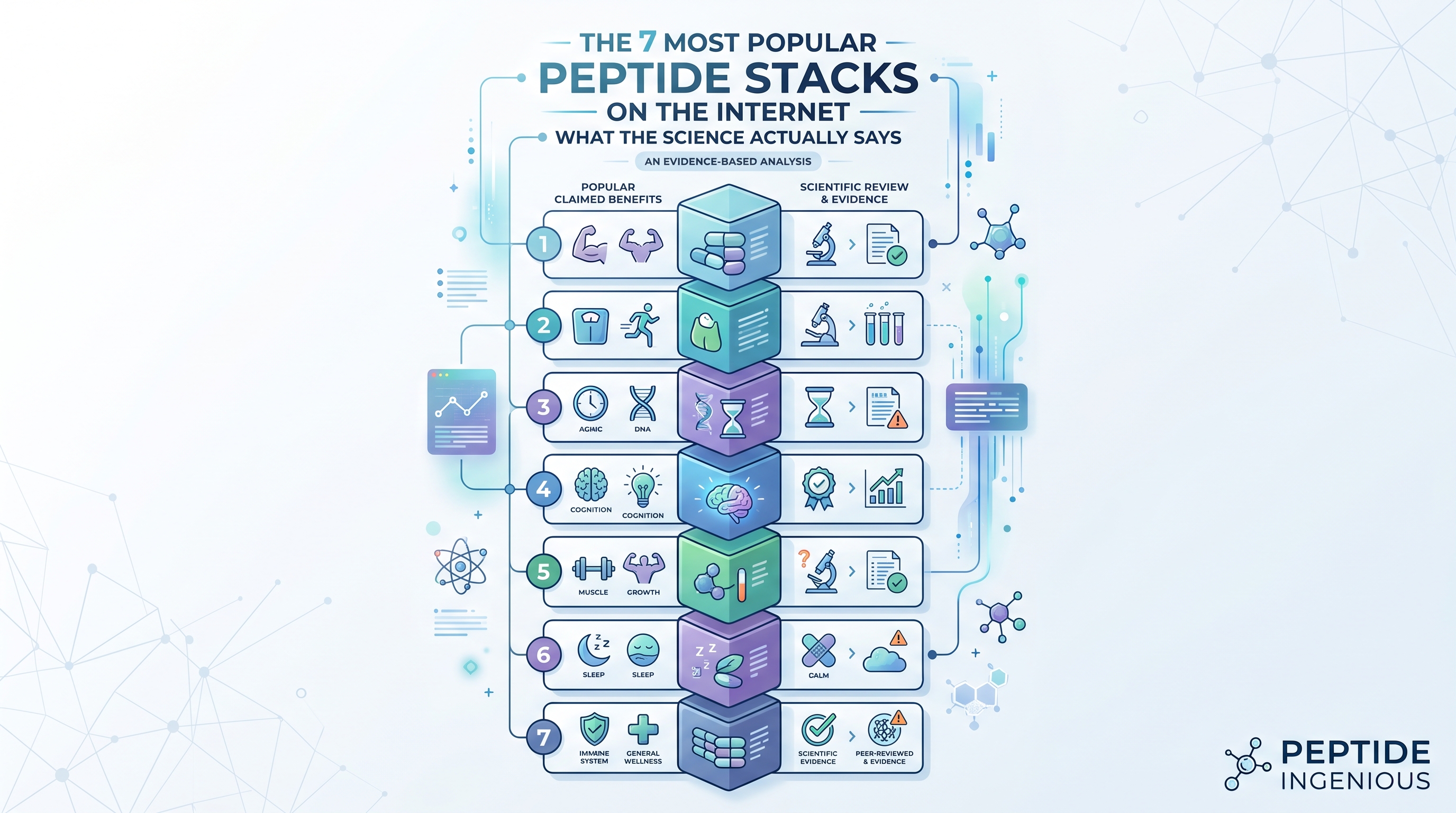
The 7 Most Popular Peptide Stacks on the Internet - What the Science Actually Says
September 29, 2026
- Introduction
- 1. Tesamorelin + Ipamorelin
- 2. Retatrutide + Tesamorelin
- 3. Sermorelin-Based Stacks
- 4. CJC-1295 + Ipamorelin + Tesamorelin
- 5. Peptide Stacks for Muscle Growth
- 6. Peptide Stacks for Fat Loss and Weight Loss
- 7. Multi-Peptide Stacking and “Starter Kits”
- What About Peptides and Testosterone Stacks?
- How Many Peptides Can You Take at Once?
- What Does “Best Peptide Stack” Actually Mean?
- Peptide Stacking vs. Single-Peptide Therapy
- What the Science Actually Says About Peptide Stacking
- What Are the Regulatory Considerations?
- How Should Peptide-Related Scientific Information Be Published Responsibly?
- What Is a Peptide Stack?
- What Are Peptide Stacks Used For?
- What Is the Best Peptide Stack?
- What Is the Best Peptide Stack for Muscle Growth?
- What Is the Best Peptide Stack for Fat Loss?
- What Is the Best Peptide Stack for Weight Loss for Women?
- Can You Stack Tesamorelin and Sermorelin?
- Can Tesamorelin and Ipamorelin Be Stacked?
- How Many Peptides Can You Take at Once?
- What Is a Peptide Stacking Chart?
- What Should You Stack With Retatrutide?
- Featured Snippet Answer: What Is a Peptide Stack?
- Medical Disclaimer
A peptide stack generally means using two or more peptide compounds together with the idea that their effects may complement one another. The science, however, is more complicated than online discussions often suggest. Some individual peptides have human clinical evidence, but that does not automatically prove that combining them is effective, safe, or synergistic. For many popular peptide stacks, the specific combination has little or no controlled human research. Popularity online should therefore be separated from clinical evidence.
Introduction
Searches for peptide stacks have expanded alongside interest in peptides for muscle growth, recovery, fat loss, body composition, and weight management. Online communities frequently discuss combinations involving growth-hormone-related peptides, metabolic peptides, and investigational compounds.
The appeal is understandable. If two compounds appear to affect related biological pathways, it may seem logical that using them together could produce a stronger result. But biological plausibility is not the same thing as clinical proof.
A peptide can have human research supporting a particular effect while a combination containing that peptide remains untested. Likewise, evidence that a compound changes a biomarker such as growth hormone or IGF-1 does not automatically demonstrate greater muscle growth, improved athletic performance, or better long-term health outcomes.
That distinction is particularly important because many peptide combinations discussed online involve compounds with different regulatory statuses and very different amounts of clinical evidence.
This article examines seven commonly discussed peptide-stack categories and combinations, focusing on what research actually shows. The goal is not to identify a winner or provide a stacking protocol. Instead, the goal is to separate established human evidence from theoretical mechanisms, limited studies, and anecdotal internet claims.
What Is a Peptide Stack?
A peptide stack is a term commonly used online to describe the combined use of multiple peptide compounds for a shared or complementary objective. Depending on the community, “stacking peptides” may refer to combining compounds believed to influence growth-hormone signaling, body composition, appetite, metabolism, recovery, or other biological processes.
The important scientific distinction is between combination therapy and simply taking several compounds at the same time.
In clinical medicine, a combination treatment is normally studied as a combination. Researchers can compare the combination with appropriate control groups and determine whether the added treatment produces additional benefits or risks.
Online peptide stacks are often different. A person may find evidence that compound A affects one pathway and compound B affects another, then assume that using both will create a synergistic effect. That assumption may be biologically plausible, but it remains an assumption unless clinical research demonstrates it.
For example, tesamorelin has been studied in humans and has an FDA-approved indication for reducing excess abdominal fat in adults with HIV-associated lipodystrophy. Ipamorelin has also been studied in humans, including pharmacokinetic and pharmacodynamic research. Those facts do not establish that a tesamorelin and ipamorelin stack provides an additional clinical benefit.
This distinction can be summarized simply:
Evidence for individual peptides is not automatically evidence for peptide stacks.
The same principle applies to CJC-1295, sermorelin, retatrutide, and other compounds. A mechanism can justify further investigation without proving that a particular combination is effective or safe.
How Strong Is the Science Behind Peptide Stacking?
The evidence behind peptide stacking varies substantially. Some individual compounds have randomized human trials, while many specific combinations discussed online have little or no direct clinical evidence. The strongest evidence comes from controlled human studies of the exact treatment being evaluated, not from combining results from unrelated studies.
| Evidence Type | What It Tells Us | Key Limitation |
|---|---|---|
| Human clinical trials | Can establish effects and safety under studied conditions | Results may apply only to the studied population, formulation, and treatment |
| Observational studies | Can identify associations and real-world patterns | Cannot reliably establish causation |
| Animal studies | Can provide biological and safety clues | Animal results may not translate to humans |
| Cell/preclinical research | Helps explain mechanisms | Does not demonstrate clinical benefit |
| Mechanistic research | Can show how a compound may influence a pathway | A plausible pathway does not prove a meaningful clinical outcome |
| Anecdotal reports | Can identify experiences or questions worth investigating | Highly susceptible to bias and cannot establish effectiveness or causation |
A randomized controlled trial of a single peptide can tell researchers what happened when that peptide was administered under defined conditions. It does not necessarily tell researchers what happens when the same compound is combined with another peptide.
That is why a peptide stacking chart found online should not be treated as equivalent to clinical evidence.
A chart may organize compounds according to proposed mechanisms or community practices, but it generally cannot establish whether a combination improves meaningful outcomes or increases adverse effects.
A recent review of peptide and peptide-analog use in bodybuilding similarly noted that clinical evidence is limited and that much published research involves controlled therapeutic applications rather than the supraphysiological or combined protocols discussed in bodybuilding communities.
The 7 Most Popular Peptide Stacks Discussed Online
The following combinations and categories are presented because they are commonly discussed in online peptide, fitness, and body-composition communities. They are not ranked by effectiveness or safety.
The central question for each is:
What evidence exists for the individual compounds, and what evidence exists for the actual combination?
1. Tesamorelin + Ipamorelin
What Is the Stack?
A tesamorelin and ipamorelin stack combines two compounds associated with growth-hormone signaling.
Tesamorelin is a growth-hormone-releasing hormone analog. It has been extensively studied in people living with HIV who have excess abdominal fat associated with lipodystrophy. FDA-approved tesamorelin products have an indication for reducing excess abdominal fat in that population and are not indicated for general weight-loss management.
Ipamorelin is a growth-hormone-releasing peptide that acts through the ghrelin receptor. Human pharmacokinetic and pharmacodynamic research has demonstrated that ipamorelin can stimulate growth hormone release.
Why Is It Popular Online?
The proposed rationale is that tesamorelin and ipamorelin influence growth-hormone signaling through different but related pathways.
Online discussions sometimes describe the combination as potentially complementary for body composition or recovery.
That is a mechanistic rationale, however, rather than proof of clinical synergy.
What Does the Science Say?
Tesamorelin has substantially stronger human clinical evidence than many compounds discussed in online peptide communities. Randomized trials have demonstrated reductions in visceral adipose tissue in appropriately selected people with HIV-associated abdominal fat accumulation. A 2026 systematic review and meta-analysis also found evidence supporting reductions in visceral adipose tissue in this population.
Ipamorelin has human research demonstrating pharmacological activity and growth-hormone stimulation. It has also been investigated in clinical research for postoperative ileus, although that study did not demonstrate a statistically significant benefit for its primary efficacy endpoint.
The critical issue is the actual combination.
Evidence that tesamorelin works under studied conditions plus evidence that ipamorelin can stimulate growth hormone does not establish that the two together produce greater fat loss, muscle growth, recovery, or another clinically meaningful outcome.
What Evidence Is Missing?
Controlled human research specifically testing the tesamorelin-ipamorelin combination for commonly advertised bodybuilding or body-composition goals is limited.
That means claims about synergy should be treated as hypotheses rather than established clinical findings.
Safety and Uncertainties
Tesamorelin can increase IGF-1 and has important warnings and contraindications. FDA labeling also identifies concerns involving glucose metabolism, fluid retention, malignancy, and other risks.
The FDA has separately identified limited safety information and potential concerns involving compounded ipamorelin acetate, including immunogenicity and peptide-related impurities.
Evidence Snapshot
- Individual-compound evidence: Human evidence exists for both compounds, but it differs substantially in scope.
- Combination evidence: Limited direct evidence for the commonly discussed combination.
- Human data: Available for individual compounds.
- Main limitation: Evidence for individual effects does not establish combination synergy.
2. Retatrutide + Tesamorelin
What Is the Stack?
The reta and tesa stack refers to combining retatrutide with tesamorelin.
Retatrutide is an investigational triple agonist that activates the GIP, GLP-1, and glucagon receptors. It is being developed primarily for metabolic conditions including obesity and related complications.
Tesamorelin works through the growth-hormone-releasing-factor pathway and has an FDA-approved indication specifically involving excess abdominal fat in adults with HIV-associated lipodystrophy.
Why Is It Popular Online?
The proposed rationale generally comes from the fact that the compounds affect different biological systems.
Retatrutide has been investigated for substantial reductions in body weight, while tesamorelin has evidence for reducing visceral adipose tissue in a specific clinical population.
Online discussions therefore sometimes ask what to stack with reta.
But combining two mechanisms does not automatically establish an additive or synergistic effect.
What Does the Science Say?
Retatrutide has progressed considerably further in clinical development than many experimental peptides. A phase 2 randomized trial involving adults with obesity demonstrated substantial weight reductions over 48 weeks.
By 2026, retatrutide had also entered large phase 3 programs. ClinicalTrials.gov lists TRIUMPH-1 as a phase 3 randomized, placebo-controlled study involving more than 2,300 participants.
However, as of this article's publication, retatrutide remains investigational and has not been approved by the FDA. The developer states that it is being evaluated in phase 3 trials and is not available for public use outside clinical research.
Tesamorelin's evidence is concentrated in HIV-associated lipodystrophy rather than general obesity treatment.
What Evidence Is Missing?
There is an important difference between studying retatrutide and tesamorelin separately and conducting a controlled trial of retatrutide plus tesamorelin.
The latter would be needed to determine whether the combination provides additional clinical benefit and whether the combined safety profile is acceptable.
Safety and Uncertainties
Retatrutide remains investigational. Products marketed outside legitimate clinical research cannot be assumed to contain the same compound, purity, concentration, or quality used in clinical trials.
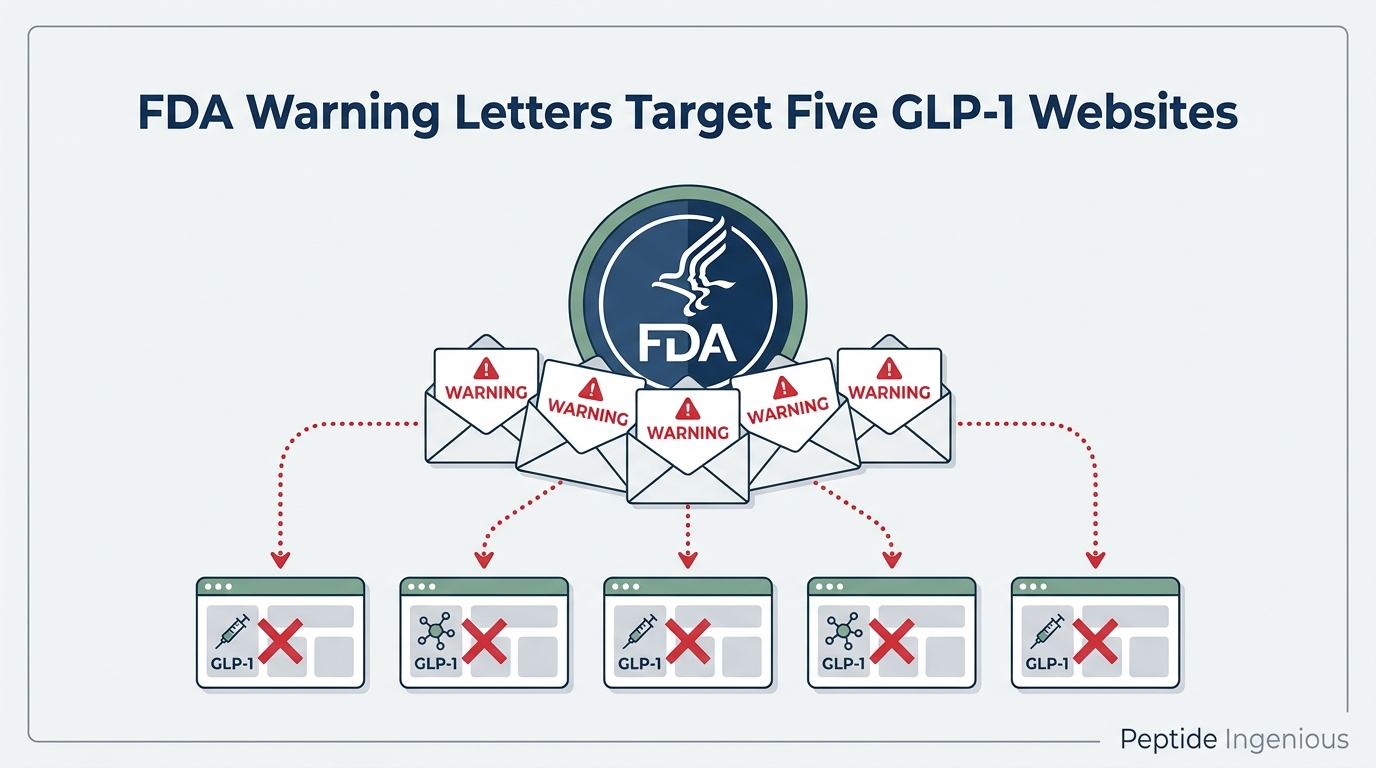
FDA has also taken enforcement action against websites marketing unapproved peptide products, emphasizing that “research use only” language does not necessarily determine whether a product is legally an unapproved drug when the surrounding claims establish intended human use.
Evidence Snapshot
- Individual-compound evidence: Substantial clinical research exists for retatrutide; tesamorelin has established human evidence for a specific indication.
- Combination evidence: No established clinical evidence demonstrating that reta plus tesa is superior to appropriate individual treatment.
- Human data: Stronger for the individual compounds than for the combination.
- Main limitation: The combination itself remains inadequately studied.
3. Sermorelin-Based Stacks
What Is the Stack?
A sermorelin stack generally refers to sermorelin being combined with one or more other compounds, often peptides associated with growth-hormone signaling.
Sermorelin is a synthetic analog of growth hormone-releasing hormone. Early human research demonstrated that GHRH-related peptides can stimulate growth hormone release.
Why Is It Popular Online?
The online rationale is usually based on the assumption that combining compounds affecting the growth-hormone axis could amplify or complement their effects.
This is where theoretical synergy can easily be mistaken for demonstrated synergy.
Can You Stack Tesamorelin and Sermorelin?
Searches for a tesamorelin and sermorelin stack often reflect the fact that both compounds are associated with growth-hormone-releasing pathways.
But the fact that two compounds affect related pathways does not demonstrate that administering them together produces a better clinical result.
There is also a practical scientific problem: if two agents act on closely related biological pathways, the combination may not necessarily produce a proportional increase in the desired outcome.
What Does the Science Say?
Sermorelin has human research showing stimulation of growth hormone release. Tesamorelin has considerably more modern clinical evidence in its approved population.
However, evidence directly establishing that tesamorelin and sermorelin together improve clinically meaningful outcomes is limited.
Safety and Uncertainties
Both compounds influence the growth-hormone axis. That makes monitoring and interpretation more complicated when multiple agents are used.
Changes in GH or IGF-1 are not equivalent to proof of increased muscle hypertrophy, improved longevity, or superior body composition.
Evidence Snapshot
- Individual-compound evidence: Human research exists.
- Combination evidence: Limited direct evidence for tesamorelin plus sermorelin.
- Human data: Primarily individual-compound or pathway research.
- Main limitation: Overlapping mechanisms do not establish additive clinical benefit.
4. CJC-1295 + Ipamorelin + Tesamorelin
What Is the Stack?
The CJC-1295 ipamorelin tesamorelin stack combines three compounds associated with growth-hormone signaling.
CJC-1295 is a long-acting growth-hormone-releasing hormone analog. A randomized placebo-controlled human study found that CJC-1295 produced sustained increases in GH and IGF-1 in healthy adults.
Ipamorelin is a growth-hormone-releasing peptide, while tesamorelin is a GHRH analog with established clinical research in HIV-associated lipodystrophy.
Why Is It Popular Online?
The proposed reasoning is that several compounds may influence the growth-hormone system through complementary mechanisms.
However, using three compounds does not automatically mean that three separate effects will combine into a larger clinical benefit.
What Does the Science Say?
Individual research demonstrates that these compounds can affect GH-related biology.
CJC-1295, for example, produced prolonged increases in GH and IGF-1 in a small human study.
Ipamorelin has also demonstrated GH stimulation in healthy volunteers.
Tesamorelin has randomized trials supporting reductions in visceral adipose tissue in its studied population.
But these studies do not constitute a clinical trial of all three compounds together.
What Evidence Is Missing?
The major missing evidence is a controlled human trial evaluating the exact three-compound combination and measuring meaningful outcomes such as muscle mass, strength, body composition, recovery, and adverse events.
Safety and Uncertainties
There may be additional uncertainty when several compounds influence the same endocrine axis.
FDA has specifically identified limited clinical data and safety concerns involving compounded CJC-1295 and ipamorelin acetate, including potential immunogenicity and peptide-related impurities.
Evidence Snapshot
- Individual-compound evidence: Human studies exist.
- Combination evidence: Limited evidence for the three-compound stack itself.
- Human data: Primarily individual compounds.
- Main limitation: No established clinical proof of three-way synergy.
5. Peptide Stacks for Muscle Growth
What Is the Stack?
Searches for the best peptide stack for muscle growth usually refer to combinations of peptides associated with growth-hormone signaling, recovery, or body composition.
Common online discussions may involve CJC-1295, ipamorelin, sermorelin, tesamorelin, and other experimental compounds.
Why Is It Popular Online?
The reasoning often starts with growth hormone.
If a compound increases GH or IGF-1, it can be tempting to assume that the compound will necessarily produce greater muscle hypertrophy.
But that conclusion does not follow automatically.
What Does the Science Say?
Human studies can demonstrate changes in hormone concentrations without demonstrating corresponding improvements in muscle size or strength.
For example, CJC-1295 has been shown to increase GH and IGF-1 in healthy adults. That establishes pharmacological activity. It does not by itself establish that a CJC-1295-containing stack increases skeletal-muscle hypertrophy in healthy adults.
Similarly, research involving GH-releasing peptides demonstrates effects on hormone secretion, but hormone changes are surrogate or mechanistic outcomes rather than proof of superior athletic performance.
A recent review of peptide and peptide-analog use in bodybuilding concluded that clinical evidence supporting peptide use in sport remains limited, with much research focused on therapeutic applications rather than the combined protocols promoted in bodybuilding communities.
What Evidence Is Missing?
For many muscle-growth peptide stacks, researchers would need controlled trials that directly measure outcomes such as:
- Lean body mass
- Muscle cross-sectional area
- Strength
- Physical function
- Recovery
- Adverse events
Without these outcomes, claims of superior muscle growth remain uncertain.
Evidence Snapshot
- Individual-compound evidence: Varies substantially.
- Combination evidence: Often limited.
- Human data: More commonly focused on pharmacology or specific medical conditions.
- Main limitation: Increased GH signaling is not synonymous with proven muscle hypertrophy.
6. Peptide Stacks for Fat Loss and Weight Loss
What Is the Stack?
Online searches for the best peptide stack for fat loss, best peptide stack for weight loss, or best peptide stack for women often combine compounds that influence appetite, metabolic signaling, visceral fat, or growth-hormone pathways.
The scientific evidence is highly uneven across these compounds.
What Does the Science Say?
Some peptide-based medications have substantial evidence for weight management.
Tirzepatide, for example, is an FDA-approved GIP and GLP-1 receptor agonist for chronic weight management in appropriate adults and for moderate-to-severe obstructive sleep apnea in adults with obesity.
Retatrutide is another example of an investigational metabolic peptide. Phase 2 research demonstrated substantial weight reduction, and by 2026 it had progressed into phase 3 development. However, it remained investigational and not FDA-approved as of publication.
Tesamorelin is different. Its FDA-approved use concerns excess abdominal fat associated with HIV lipodystrophy, not general weight-loss management.
This illustrates why the term “fat-loss peptide” can be misleading. Weight loss, fat loss, visceral-fat reduction, and preservation of lean mass are different outcomes.
What About Women?
Searches such as best peptide stack for weight loss female, peptide stack for women, and best peptide stack for women should not be interpreted as proof that a separate universal female stack exists.
Sex can affect drug pharmacology and clinical outcomes, but a claim that a particular peptide combination is specifically superior for women requires evidence from appropriately designed studies.
What Are “Cutting Peptides”?
“Cutting peptides” is primarily an online fitness term rather than a formal medical classification.
It can refer to compounds marketed or discussed for reducing body fat while preserving lean mass. The scientific question is whether a particular compound or combination has controlled human evidence for those outcomes.
Evidence Snapshot
- Individual-compound evidence: Strong for some FDA-approved metabolic medications; limited or investigational for others.
- Combination evidence: Much more limited than individual-drug evidence.
- Human data: Varies considerably by compound and indication.
- Main limitation: Weight reduction does not automatically prove fat-loss, muscle-preservation, or combination benefits.
7. Multi-Peptide Stacking and “Starter Kits”
What Is a Multi-Peptide Stack?
A peptide starter kit or multi-peptide stack generally refers to a group of compounds marketed or discussed together for multiple goals.
Online peptide stacking charts may organize compounds according to categories such as fat loss, muscle growth, recovery, or growth-hormone signaling.
How Many Peptides Can You Take at Once?
There is no universal evidence-based number of peptides that applies safely to everyone.
The answer depends on the individual compounds, their pharmacology, the person's health status, potential interactions, product quality, and the amount of clinical research available for the specific combination.
Adding more compounds also makes adverse events harder to attribute.
If a person experiences a reaction while taking five different substances, determining which compound caused the event can be considerably more difficult than when only one treatment is involved.
Why Online Charts Can Be Misleading
A chart can make a complicated biological system appear straightforward.
For example, listing three compounds under “growth hormone” does not demonstrate that using all three together is effective. Similarly, placing several compounds under “fat loss” does not establish that the combination improves clinically meaningful weight-management outcomes.
FDA has raised specific concerns about the safety information available for several compounded peptides, including CJC-1295 and ipamorelin acetate.
Evidence Snapshot
- Individual-compound evidence: Highly variable.
- Combination evidence: Frequently absent or limited.
- Human data: Depends on the exact compounds.
- Main limitation: More compounds can mean more uncertainty, interactions, and difficulty attributing adverse effects.
What About Peptides and Testosterone Stacks?
A peptides and testosterone stack combines peptide compounds with testosterone, usually in the context of discussions about muscle growth, body composition, or hormone optimization.
Testosterone is fundamentally different from many compounds described as “peptides.” Testosterone is a steroid hormone, not a peptide, and FDA-approved testosterone products are prescription therapies used for specific medical indications.
The FDA continues to regulate testosterone products and updated testosterone prescribing information in 2026 following review of newer safety data.
Combining testosterone with another pharmacologically active compound introduces additional variables.
A theoretical difference in biological pathways does not establish that the combination produces better outcomes. Likewise, evidence supporting testosterone therapy for an appropriate medical indication does not establish the safety or efficacy of adding an experimental peptide.
This is particularly important because online discussions may treat all hormone-active compounds as interchangeable. They are not.
How Many Peptides Can You Take at Once?
There is no single scientifically established number of peptides that everyone can safely combine.
The relevant question is not simply how many, but which compounds, why they are being used, how they interact, what evidence exists, and what risks have been studied.
Researchers would ideally have controlled human data on the exact combination before making conclusions about its safety and efficacy.
Potential problems with multiple-compound use include:
- Overlapping biological effects
- Drug-drug interactions
- Additive adverse effects
- Uncertain pharmacokinetics
- Difficulty identifying the cause of an adverse event
- Limited long-term safety data
- Differences between research-grade study materials and commercially marketed products
Therefore, an online statement such as “these peptides can be stacked together” should not be interpreted as proof of clinical compatibility.
What Does “Best Peptide Stack” Actually Mean?
“Best peptide stack” is a popular search query, but best is not a scientific category unless the question is clearly defined and supported by comparative evidence.
For example, the answer could change depending on whether the intended outcome is:
- Weight reduction
- Visceral-fat reduction
- Lean-mass preservation
- Muscle hypertrophy
- Strength
- Recovery
- Treatment of a specific medical condition
A scientifically meaningful comparison should consider questions such as:
| Question | Why It Matters |
|---|---|
| Has the individual compound been studied in humans? | Human evidence is more directly relevant to human outcomes. |
| Has the actual combination been studied? | Individual evidence cannot prove combination efficacy. |
| Is the intended use FDA-approved? | Regulatory status provides important context about evidence and authorized use. |
| Are known interactions documented? | Combining treatments can introduce additional risks. |
| What safety data exist? | Efficacy without adequate safety information is incomplete evidence. |
| What remains unknown? | Uncertainty is part of responsible scientific interpretation. |
This framework is more informative than choosing a “best peptide stack” from internet popularity.
Peptide Stacking vs. Single-Peptide Therapy
Single-compound studies are generally easier to interpret because researchers can attribute observed outcomes more directly to the treatment being studied.
Combination therapy introduces additional variables.
If compound A changes a biomarker and compound B changes the same biomarker, using both may produce:
- An additive effect
- No additional effect
- A less-than-additive effect
- An unexpected interaction
- An increase in adverse effects
Only controlled research can reliably distinguish these possibilities.
This is why anecdotal reports about stack peptides or stacking peptides should be interpreted cautiously.
A person may report feeling stronger, losing weight, recovering faster, or experiencing fewer side effects after adding another compound. That experience may be genuine, but it cannot establish that the added peptide caused the improvement.
Other factors may have changed simultaneously, including diet, training, sleep, body weight, other medications, or expectations.
What the Science Actually Says About Peptide Stacking
The most defensible conclusion is that peptide stacking is a broad internet practice, not a single clinically validated treatment strategy.
Some individual peptides have meaningful human research.
Tesamorelin, for example, has randomized clinical evidence supporting reduction of visceral adipose tissue in adults with HIV-associated lipodystrophy, and its FDA-approved indication is specifically defined around that population.
CJC-1295 has human pharmacological evidence showing sustained increases in GH and IGF-1. Ipamorelin has human evidence demonstrating stimulation of GH release.
Retatrutide has progressed through phase 2 and phase 3 clinical development for obesity and related conditions, but remains investigational as of this publication.
Those facts are useful.
But none of them proves that the popular combinations discussed online are superior to appropriate single-compound treatment.
The strongest distinction is therefore:
Individual evidence tells us what a compound may do. Combination evidence tells us what the combination does.
A theoretical biological rationale can justify a clinical study. It cannot substitute for one.
For many peptide stacks, the evidence currently consists of a mixture of individual-compound studies, mechanistic reasoning, limited clinical research, and anecdotal reports.
That does not mean every combination is ineffective. It means the available evidence may not be sufficient to determine effectiveness, safety, or synergy.
What Are the Regulatory Considerations?
Regulatory status is another area where online peptide discussions can become confusing.
FDA-approved peptide medications have undergone a defined regulatory review process for their approved indications.
Other compounds may be investigational, compounded, off-label, or otherwise outside an approved indication.
Retatrutide, for example, remains investigational and has not been approved by the FDA as of September 2026. Lilly states that the compound is being studied in phase 3 trials and is not available for public use outside clinical trials.
FDA has also warned about unapproved peptide products sold online. In 2026, FDA warning letters identified multiple peptide products as unapproved new drugs when website claims established intended human use, even when sellers used “research use only” language.
This distinction matters because the label on a website does not independently establish that a product is FDA-approved, safe, or suitable for human use.
FDA also explains that compounded drugs are not FDA-approved and are not reviewed before marketing in the same way as FDA-approved drugs for safety, effectiveness, and quality. Poor compounding can create risks involving contamination, strength, quality, or purity.
How Should Peptide-Related Scientific Information Be Published Responsibly?
Peptide-related websites face a particular communication challenge because readers may encounter scientific terminology alongside marketing claims.
Responsible content should make clear:
- Which compounds have FDA-approved indications.
- Which compounds remain investigational.
- Whether evidence comes from humans or preclinical research.
- Whether research studied an individual compound or the actual combination.
- What outcomes were measured.
- What limitations the researchers identified.
- Which claims remain theoretical or anecdotal.
A strong scientific article should also avoid turning mechanistic findings into promises.
For example, “increased GH secretion was observed” is a scientific statement.
“Produces superior muscle growth” is a much stronger claim and requires direct evidence for that outcome.
For peptide businesses building educational content around these subjects, specialized digital agencies such as Peptide Ingenious work on areas including peptide-specific SEO and AEO, compliant website development, conversion optimization, compliance monitoring, and digital strategy for peptide brands. The role of such services is digital communication and website strategy not medical diagnosis, prescribing, or clinical validation. Peptide Ingenious
The same principle applies to SEO: optimizing a scientific article should make accurate information easier to discover, not make unsupported claims appear more authoritative.
Frequently Asked Questions
What Is a Peptide Stack?
A peptide stack is the combined use of two or more peptide compounds, usually based on the idea that their biological effects may complement one another. Scientific evidence for the individual compounds does not automatically establish that the combination is effective, safe, or synergistic.
What Are Peptide Stacks Used For?
Online discussions commonly associate peptide stacks with muscle growth, fat loss, weight management, recovery, body composition, and growth-hormone signaling. The scientific evidence varies substantially by compound and intended use, and many specific combinations have not been adequately studied in controlled human trials.
What Is the Best Peptide Stack?
There is no scientifically established universal “best peptide stack.” The appropriate evidence depends on the intended outcome, the compounds involved, their regulatory status, individual safety data, and whether the exact combination has been studied in humans.
What Is the Best Peptide Stack for Muscle Growth?
No particular peptide stack can be identified as the scientifically established best option for muscle growth. Some peptides influence growth-hormone signaling, but changes in GH or IGF-1 do not automatically demonstrate greater muscle hypertrophy or strength.
What Is the Best Peptide Stack for Fat Loss?
There is no universal evidence-based “best fat-loss stack.” Some peptide medications have substantial human evidence for weight management, while other compounds discussed online are investigational or have limited evidence. Combination claims require direct evidence for the actual combination.
What Is the Best Peptide Stack for Weight Loss for Women?
There is no universally established peptide stack specifically proven to be the best for women's weight loss. Evidence should be evaluated according to the individual compound, the population studied, the outcome measured, and whether women were adequately represented in the relevant clinical trials.
Can You Stack Tesamorelin and Sermorelin?
Tesamorelin and sermorelin both influence growth-hormone-releasing pathways, which is part of the rationale behind online discussions of combining them. However, related mechanisms do not establish that the combination provides additional clinical benefit, and direct evidence for the combination is limited.
Can Tesamorelin and Ipamorelin Be Stacked?
Tesamorelin and ipamorelin have both been studied individually in humans, but evidence for the combination is much more limited. Human evidence for each compound separately should not be interpreted as proof that using them together produces superior outcomes.
How Many Peptides Can You Take at Once?
There is no universal evidence-based number of peptides that everyone can safely combine. The relevant considerations include the individual compounds, interactions, overlapping biological effects, product quality, health status, and the amount of research available on the exact combination.
What Is a Peptide Stacking Chart?
A peptide stacking chart is usually an online table that groups peptides according to proposed goals or mechanisms. Such charts can be useful for organizing information, but they should not automatically be treated as clinical guidance or proof that the listed combinations are safe or effective.
What Should You Stack With Retatrutide?
There is no established evidence-based peptide combination that should routinely be added to retatrutide. Retatrutide remains investigational as of September 2026, and research on retatrutide combinations should be distinguished from research evaluating retatrutide alone.
Featured Snippet Answer: What Is a Peptide Stack?
A peptide stack is a combination of two or more peptide compounds used together based on a proposed complementary effect. However, evidence for each peptide individually does not prove that the combination is safe, effective, or synergistic. Many popular peptide stacks have limited or no controlled human research on the exact combination.
Medical Disclaimer
This article is for educational and informational purposes only. It does not provide medical advice, diagnosis, treatment, dosing, administration instructions, or individualized recommendations. Peptides and peptide-related drugs can have significant risks, interactions, regulatory restrictions, and differences in evidence. Readers should discuss medical treatment decisions with a qualified healthcare professional.